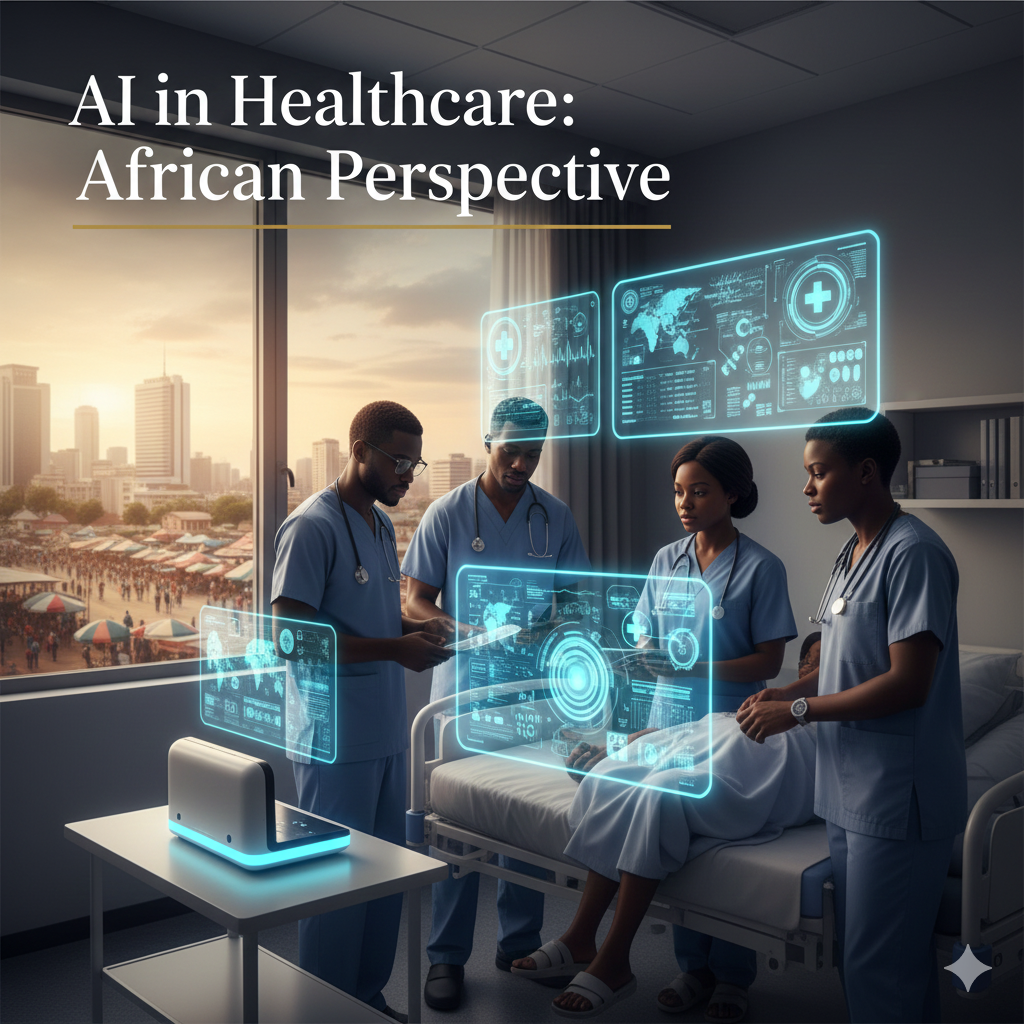
AI in Healthcare: The African Perspective
The market for AI in healthcare across the Middle East & Africa (MEA) region is exhibiting accelerated growth, with revenue projected to reach US$ 1.4 billion by 2030 from US$ 193.1 million in 2023, translating to a robust Compound Annual Growth Rate (CAGR) of 33.6%.1
AI applications are demonstrating tangible impacts across diagnostics, achieving efficiency gains such as approximately 90% faster TB/HIV diagnosis in pilot programs 2, and operational improvements, including a 40% reduction in claims processing time for some providers in South Africa.2
This momentum is supported by the health tech sector’s unique resilience, which recorded a 7% year-on-year growth in funding.3
Nevertheless, strategic investment are needed to focus on closing the foundational infrastructure and data gaps that are still very prevalent in order to realise the full potential of AI for continental health self-reliance.
AI as an Accelerator for African Health Systems
Bridging Resource and Access Gaps
African healthcare systems face persistent, intersecting challenges defined by a high disease burden that encompasses communicable diseases like HIV/AIDS, malaria, and tuberculosis, alongside rising non-communicable diseases (NCDs) such as cancer and diabetes.6
These clinical pressures are exacerbated by severe shortages of qualified healthcare personnel and endemic infrastructure deficits, particularly in remote areas.7 The conventional, resource-intensive models of healthcare delivery are proving insufficient to meet the needs of rapidly growing populations.
In this context, Artificial Intelligence is not viewed merely as a tool for incremental enhancement, but as a crucial mechanism for leapfrogging traditional constraints.7 AI’s potential to enhance patient care, reduce clinician burnout, and improve overall outcomes is key to accelerating progress toward Sustainable Development Goal 3 (Good Health and Wellbeing).9
Given the dramatic withdrawal of external funding and the worsening financial constraints facing African health systems, a more radical approach to technology adoption is necessary than in high-income countries.10
AI’s capacity to deliver what some refer to as “free intelligence” can form the backbone of a higher quality, more cost-effective health system, provided it is built on a pragmatic foundation of local realities.10
Connectivity and the Paradox of Access
The potential for AI deployment is anchored in the widespread adoption of mobile technologies across the continent. Mobile phone penetration rates often exceed 80% in many parts of Africa.7
This strong foundation supports the rapid uptake of mobile health (mHealth) systems, which are already demonstrating value through simple interventions like SMS reminders and mobile applications used for managing chronic conditions such as hypertension and diabetes.12
However, this mobile ubiquity exists in tension with severe limitations in foundational digital infrastructure. Data reveal a significant divide: while mobile use is high, only 37% of Africans were online in 2023.4
Moreover, specific data points indicate that regular internet access in Sub-Saharan Africa (SSA) falls as low as 28% of the population.14 This infrastructure deficit presents a fundamental obstacle, restricting the viability of sophisticated AI-based systems that require continuous high-bandwidth connectivity and robust computational resources.8
This creates a “Policy versus Plumbing” paradox. While the African Union (AU) adopted its comprehensive AI Continental Strategy in June 2024 4, which outlines priorities for harmonised governance and capacity building, the pace of high-level policy formulation risks outpacing the speed of capital-intensive infrastructure deployment.
Realising the continent’s immense economic potential, which includes capturing 10% of the global AI market, potentially contributing 50% of Africa’s 2024 GDP 9, requires treating investment in data, power, and digital infrastructure not just as a social expenditure but as a central strategy for macroeconomic growth and stability.
The AI in Health Market and Investment Dynamics
Market Size and Projected Growth
The Middle East and Africa (MEA) region is emerging as a global hotspot for AI in healthcare market expansion. Revenue generated by this market reached US$ 193.1 million in 2023.1 Analysts project rapid and sustained growth, with the market expected to swell to US$ 1.4 billion by 2030.1
This expansion is underpinned by a forecasted Compound Annual Growth Rate (CAGR) of 33.6% from 2024 to 2030.1 The primary driver of this market maturation is the adoption of Software Solutions, which is identified as both the largest revenue-generating and fastest-growing component segment.1
This suggests that African adoption strategies prioritise rapid deployment and scalability across varied existing infrastructure, favouring capital-light software over specialised, expensive hardware integration.
While Saudi Arabia is projected to register the highest CAGR within the broader MEA region, key anchor economies in Sub-Saharan Africa, notably South Africa and Nigeria, are driving the bulk of activity in the continent’s healthcare technology sector.1
Health Tech Investment Hotspots: Review of 2024 Funding Trends
Despite global economic volatility, Africa’s health tech industry demonstrated remarkable resilience in 2024. It was reported as the only sector to experience a year-on-year growth in funding, with an increase of 7%.3
This counter-cyclical investment trend suggests that capital allocation is being driven by the acute necessity arising from the continent grappling with the highest disease rates globally, confirming investor belief in the sector’s urgency and long-term viability.3
The total capital attracted by health tech startups across Africa was significant, exceeding $500 million in 2024.15 This private investment is complemented by robust institutional support.
The African Development Bank, for instance, allocated $1 billion to health projects in 2024, explicitly earmarking funding for health tech innovations and infrastructure development. Such public-private partnerships are crucial for building the foundational systems necessary to scale AI technologies continent-wide.15
The following table summarises the primary economic and infrastructural metrics driving the AI in African healthcare discourse:
Table 1: Key Market and Economic Statistics for AI in African Healthcare
Metric | Figure / Range | Scope / Period | Source Context |
MEA AI in Healthcare Market Revenue | US$ 193.1 million | 2023 | Middle East & Africa (MEA) 1 |
MEA AI in Healthcare Projected Revenue | US$ 1,468.4 million | 2030 | Middle East & Africa (MEA) 1 |
MEA AI in Healthcare CAGR | 33.6% | 2024-2030 | High growth projection for the region 1 |
Africa Health Tech Startup Funding | Over $500 million | 2024 | Global confidence and sector resilience 15 |
Sub-Saharan Africa Internet Connectivity Rate | 37% | 2023 | Foundational infrastructure barrier 4 |
Health Tech Funding Growth Rate | 7% Year-on-Year Increase | Recent Period | Only sector to experience YoY growth 3 |
Application Spectrum and Measured Clinical Impact
AI’s role in African healthcare extends across clinical and operational domains, moving beyond theoretical models to deliver measurable, quantifiable improvements in efficiency and diagnostic speed.
Focus Area A: Diagnostics and Disease Surveillance
AI is being actively deployed to manage and survey infectious diseases that constitute a major portion of Africa’s health burden, including HIV/AIDS, malaria, tuberculosis, and Ebola.6
The speed gains are particularly transformative in outbreak management and patient outcomes. For instance, in pilot programs in Malawi, AI systems demonstrated the capacity for approximately 90% faster TB/HIV diagnosis.2 This drastic reduction in turnaround time is critical for initiating timely treatment and curbing community transmission.
In the diagnosis of malaria, a major public health challenge, the Makerere University’s AI Health Lab in Uganda has developed algorithms capable of reading blood smears with high accuracy.
Furthermore, deep-learning systems such as YOLOv5, paired with transformers, have achieved expert-level performance in parasite detection across West Africa.17
A particularly crucial development in data governance and collaboration is a recent federated learning project spanning eight African countries.17 This project enables participating hospitals to collectively train diagnostic models to interpret chest X-rays for TB without requiring the physical sharing of sensitive patient data.17
This technical solution simultaneously addresses the need for large, diverse regional datasets and the imperative for data sovereignty and protection, a cornerstone of AU policy.4
Beyond infectious diseases, AI is contributing to research on Non-Communicable Diseases (NCDs), with Egypt (25.00% for diabetes; 43.28% for cancer), Morocco, and South Africa leading the continent in research output related to AI and digital technology applied to these areas.6
Focus Area B: Health System Optimisation and Logistics
The true value proposition of AI in resource-constrained environments often lies in optimising administrative and logistical functions, thereby maximising the efficiency of limited human capital.
Operational data from South Africa highlight these gains: AI deployment in claims processing resulted in a 40% reduction in claims processing time and a remarkable 60% reduction in manual effort.2
This operational streamlining saves service providers, who are often stretched thin, over 30 hours of staff time per month.2 In a setting with a chronic shortage of healthcare workers, using AI to reduce manual workload effectively creates a human capital multiplier effect, allowing scarce professional time to be redirected from administration to direct patient care.
In pharmaceutical supply chains, which are historically hampered by fragmentation and infrastructure deficiencies 18, AI technology is being adopted to enhance resilience. By optimising delivery routes, AI can reduce transportation time and fuel consumption.19
Crucially, it facilitates a shift from conventional forecasted drug distribution (a ‘push’ method) to a real-time informed push system.18 This increased agility is essential for ensuring the integrity and timely delivery of essential, temperature-sensitive medical goods, such as vaccines, across challenging geographical terrains.
Focus Area C: Telehealth and Patient Engagement
AI-driven tools are enhancing accessibility and personalisation in patient interactions. Generative AI is utilised to produce interactive visual, oral, and text narratives tailored to guide patients, such as those living with Type II Diabetes, on essential lifestyle changes. Testing of these tools is actively underway in areas like the Western Cape of South Africa.20
For sensitive public health issues, AI-powered chatbots are being tested for HIV prevention in Zimbabwe and South Africa, providing confidential, timely, and empathetic information to young people.17
Furthermore, AI agents can provide personalisation to established mHealth services, such as enhancing maternal care programs like South Africa’s MomConnect.12 To ensure these systems are inclusive and equitable, especially given high language diversity and varying literacy levels 13, the development of multilingual and voice-enabled AI agents is recognised as a vital strategy.12
The following table synthesises the quantifiable impact observed in clinical and operational settings:
Application Area | Metric of Impact | Quantified Improvement | Context / Location |
Diagnostics | |||
Tuberculosis & HIV | Diagnosis turnaround time | ~90% faster | Malawi |
Malaria | Diagnostic accuracy | Expert-level performance | Uganda & West Africa (YOLOv5 model) |
Healthcare Operations | |||
Claims processing | Processing time | ↓ 40% | South Africa |
Administrative tasks | Manual effort | ↓ 60% | South Africa |
Staff Efficiency | Staff time recovered per month | >30 hours saved | South African healthcare providers |
Health Workforce Capacity | Adequate digital literacy rate | 51.8% | Health professionals in Ethiopia |
Navigating Foundational Barriers to Scale
While the potential impact of AI is profound, its scalability is critically constrained by persistent deficits in infrastructure, data, and human capacity. These structural hurdles must be addressed concurrently to prevent AI from simply exacerbating existing health inequalities.14
Infrastructure and Connectivity Deficits
The scaling of sophisticated AI solutions is fundamentally restricted by high computational costs and insufficient computational infrastructure across the continent.4 A pragmatic limitation acknowledged by health leaders is that AI cannot solve basic utility problems: if a health facility lacks fundamental necessities like reliable electricity or water, digital tools offer little added value.11
The digital divide poses the most substantial operational challenge. The fact that only 28% of the Sub-Saharan African population has regular internet access 14 significantly compromises the viability of cloud-based AI systems necessary for real-time disease surveillance, extensive telehealth services, and continuous data updates.21
Deployments must therefore be optimised for highly intermittent connectivity and low computational resources, often requiring edge computing solutions to bridge the gap between strong mobile penetration and poor fixed-line internet access.
Data Poverty, Bias, and Localisation
One of the most profound challenges is the reliance on models trained on non-African data. Because the majority of global AI applications are developed outside the continent, they utilise datasets that do not reflect the distinct physiological, genetic, and socio-economic realities of African populations.23
This creates a high risk of algorithmic bias, which can lead to reduced sensitivity, poor performance, or unintended discrimination when applied in African clinical settings.23
Health authorities, including the Africa CDC, are clear that the most effective way to address this bias is by developing algorithms trained exclusively on African data that accurately reflect local populations and environments.11
The core structural issue is the “Foundational Constraint Chain”: lack of robust digital infrastructure prevents the effective digitisation of medical records (EMRs), which in turn leads to a critical scarcity of local, structured, high-quality training data.14
This chain forces a dependence on external models, raising concerns about long-term sustainability and data sovereignty.8 Efforts are underway to address this, including a $2.25 million partnership between Google.org, UNECA, and PARIS21 aimed at modernising Africa’s public data infrastructure to improve data availability and quality for sectors like health.25
Workforce and Capacity Development
The scarcity of skilled personnel and the lack of local capacity to maintain and adapt AI systems present a severe threat to sustainability.8 This is compounded by a quantifiable deficit in digital literacy within the current healthcare workforce.
A study of health professionals in Ethiopia found that nearly half (48.2%) exhibited poor digital literacy levels, with only 51.8% judged to have adequate digital literacy.5
This digital literacy gap acts as a human capital bottleneck. Even technically perfect, locally relevant AI tools may fail at the point of care due to user unfamiliarity or mistrust.26
Furthermore, the implementation of complex systems is threatened by “brain drain,” the phenomenon where highly skilled African AI and technical talent is recruited to high-income countries.14
Successful adoption requires proactive policy measures focused on talent retention and scaled-up, mandatory digital upskilling programs to ensure clinical acceptance and effective usage.4
Governance, Ethics, and Responsible AI Deployment
African governing institutions are engaging proactively with AI regulation, recognising that effective governance is a prerequisite for equitable and sustainable technology adoption.
Continental Policy Milestones and Harmonisation
The political commitment to regulating AI at a continental level is strong. The African Union adopted its AI Continental Strategy in June 2024, which provides a harmonised vision for AI governance, talent retention, and cross-border data sharing tailored to African contexts and cultures.4
Building on this, the African Union Development Agency (AUDA-NEPAD) is leading the charge in regulatory preparedness within the health sector. AUDA-NEPAD is developing a phased framework designed to help national regulators incrementally adopt AI in healthcare.27
This framework emphasises key structural requirements, including the promotion of secure regional data sharing networks for AI training and the implementation of standardised clinical evaluation protocols.27
These protocols are vital for maintaining consistency in AI diagnostics, which in turn builds confidence among healthcare providers and patients, particularly when implementing sensitive solutions in public health areas like pandemic preparedness.28
Regulatory Progress and Data Protection
Regulatory acceleration across the continent is evident, especially concerning data privacy. By February 2025, a total of 40 African countries had enacted or strengthened data protection laws to address AI-related privacy concerns.4
This rapid legislative activity provides a necessary foundation for handling sensitive health data at scale, reducing legal risk for technology developers and signalling regulatory maturity to potential investors.
At the national level, countries such as Tunisia and Zambia have introduced ethical AI guidelines that specifically emphasise the principles of transparency and fairness in AI deployment.4
These national efforts align with broader international ethical frameworks, such as the UNESCO ‘Recommendation on the Ethics of Artificial Intelligence’ (2021), which establishes core principles like Human Rights, Proportionality, and the duty to Do No Harm, applicable to all 194 member states.29
Ethical Stewardship and Data Sovereignty
The ongoing governance discourse centres on ensuring African ownership and self-reliance, with policy frameworks designed to safeguard data sovereignty.11 Health leaders stress that partnerships with external private and technology actors must respect national sovereignty and prioritise ethical use and data protection.11
This focus is a strategic response to global economic dynamics and geopolitical tensions surrounding data ownership.14
Crucially, governance must actively promote equity. AUDA-NEPAD’s framework includes guidelines on affordability and accessibility, designed to ensure that AI healthcare solutions penetrate underserved areas, thus mitigating the risk that sophisticated technology becomes accessible only to wealthy urban centers.26
Without careful consideration of local contexts and these affordability mandates, AI implementation risks exacerbating, rather than mitigating, existing health inequalities.14
Conclusion
Synthesis: Opportunity Meets Obligation
Artificial Intelligence presents Africa with a unique opportunity to address its chronic healthcare challenges through innovation, efficiency, and scaled-up access. The continent has established a strong policy foundation (AU 2024 Strategy), demonstrated market resilience (7% health tech funding growth), and achieved proven clinical gains.
However, the full promise of this $1.468 billion market projection is severely contingent upon overcoming fundamental structural deficits: the foundational infrastructure gap (37% internet access) and the persistent human capital barrier (48.2% poor digital literacy among health workers).
The next phase of AI deployment requires moving beyond pilot projects to large-scale, sustainable systems driven by local data and ethical governance.
Strategic Recommendations for Stakeholders
6.2.1 For Governments and African Union Bodies
- Prioritise Foundational Infrastructure Investment: Governments, supported by bodies like the African Development Bank (which allocated $1 billion to health projects in 2024 15), must strategically direct funds toward bridging the connectivity gap and investing in regional cloud and high-performance computing centres necessary to host large-scale AI training models. This investment should be recognized as critical economic infrastructure, not solely a healthcare cost.
- Mandate Local Data Generation and Stewardship: Policy frameworks must enforce the ethical generation of large, high-quality, African-specific datasets. Utilizing methods such as federated learning—proven effective across eight African countries for TB analysis 17—should be standard practice to train unbiased models while maintaining data sovereignty and complying with the data protection laws now in place across 40 countries.4
- Implement Scaled Digital Literacy Programs: To combat the low digital literacy rate among health professionals 5, governments must integrate mandatory, comprehensive digital upskilling programs into all medical and public health education curricula. This ensures that the workforce is prepared to adopt and correctly utilize AI tools at the point of care.
6.2.2 For Investors and Technology Developers
- Develop Hybrid, Low-Resource Solutions: Investment must target technologies optimized for Africa’s reality, focusing on AI models that function effectively with intermittent connectivity, utilize edge computing, and require low computational resources. This ensures that AI benefits are not confined to well-resourced urban hospitals but reach remote, underserved populations, aligning with equity mandates.27
- Focus on Operational Efficiency and Cost Reduction: While clinical diagnostics are critical, investors should prioritize solutions that demonstrate clear operational efficiency gains, such as those cutting manual effort by 60%.2 Quantifying the return on investment in terms of staff time recovered and operational savings provides a more immediate, measurable justification for adoption in financially strained systems.
- Ensure Affordability and Accessibility: All AI solution roadmaps should incorporate strategies to ensure the technology is financially accessible for low-income settings, adhering to the principles outlined by AUDA-NEPAD. This focus ensures that the deployment of AI actively mitigates health inequalities and catalyzes movement toward universal health coverage, fostering resilience and self-reliance.11
References
- Middle East & Africa AI In Healthcare Market Size & Outlook, 2030, https://www.grandviewresearch.com/horizon/outlook/ai-in-healthcare-market/mea
- How AI Is Helping Healthcare Companies in South Africa Cut Costs and Improve Efficiency, https://www.nucamp.co/blog/coding-bootcamp-south-africa-zaf-healthcare-how-ai-is-helping-healthcare-companies-in-south-africa-cut-costs-and-improve-efficiency
- How Africa’s Health Tech Industry is Stacking Up in 2024, https://www.foundersfactory.africa/blog/africas-health-tech-industry-stacking-up-2024
- The State of AI in Africa Report | CIPIT, https://aiconference.cipit.org/documents/the-state-of-ai-in-africa-report.pdf
- Digital literacy level and associated factors among health professionals in a referral and teaching hospital – PubMed Central, https://pmc.ncbi.nlm.nih.gov/articles/PMC10126829/
- Impact of artificial intelligence and digital technology-based diagnostic tools for communicable and non-communicable diseases in Africa – PMC – NIH, https://pmc.ncbi.nlm.nih.gov/articles/PMC12242046/
- Tech for Healthcare in Africa: Bridging Gaps and Transforming Lives – CSM Technologies, https://www.csm.tech/blog-details/blog_pdf/tech-for-healthcare-in-africa-bridging-gaps-and-transforming-lives
- Challenges of Implementing AI in Low-Resource Healthcare Settings – ResearchGate, https://www.researchgate.net/publication/394275718_Challenges_of_Implementing_AI_in_Low-Resource_Healthcare_Settings
- Africa Development Insights, https://www.undp.org/sites/g/files/zskgke326/files/2024-07/undp_africa_africa_devt_insights-_ai_q2-2024_0.pdf
- How AI is reshaping the future of healthcare and medical research – Microsoft, https://www.microsoft.com/en-us/research/podcast/how-ai-is-reshaping-the-future-of-healthcare-and-medical-research/
- Africa CDC’s vision for AI-driven primary health care and self-reliance – News-Medical.net, https://www.news-medical.net/news/20251027/Africa-CDCe28099s-vision-for-AI-driven-primary-health-care-and-self-reliance.aspx
- How AI Agents Can Transform Healthcare Across Africa – IQVIA, https://www.iqvia.com/locations/middle-east-and-africa/blogs/2025/11/how-ai-agents-can-transform-healthcare-across-africa
- Assessment of the Barriers and Enablers of the Use of mHealth Systems in Sub-Saharan Africa According to the Perceptions of Patients, Physicians, and Health Care Executives in Ethiopia: Qualitative Study – Journal of Medical Internet Research, https://www.jmir.org/2024/1/e50337/
- Artificial intelligence in global health: An unfair future for health in Sub-Saharan Africa? | Health Affairs Scholar | Oxford Academic, https://academic.oup.com/healthaffairsscholar/article/3/2/qxaf023/8002318
- Global Health Solutions: Africa’s Contributions in 2024 – African Leadership Magazine, https://www.africanleadershipmagazine.co.uk/global-health-solutions-africas-contributions-in-2024/
- Scaling up artificial intelligence to curb infectious diseases in Africa – PMC – NIH, https://pmc.ncbi.nlm.nih.gov/articles/PMC9634158/
- The Ethics of AI-Driven Health Projects in Africa | Think Global Health, https://www.thinkglobalhealth.org/article/the-ethics-of-ai-driven-health-projects-in-africa
- Digital Transformation in Pharmaceutical Supply Chain: An African Case – ResearchGate, https://www.researchgate.net/publication/377471436_Digital_transformation_in_pharmaceutical_supply_chain_An_African_case
- Leveraging AI to optimize vaccines supply chain and logistics in Africa – PubMed Central, https://pmc.ncbi.nlm.nih.gov/articles/PMC11862030/
- African Health Stories – Microsoft Research, https://www.microsoft.com/en-us/research/project/african-health-stories/
- Artificial Intelligence for Public Health Surveillance in Africa: Applications and Opportunities, https://arxiv.org/html/2408.02575v1
- Challenges and opportunities of artificial intelligence in African health space – PMC – NIH, https://pmc.ncbi.nlm.nih.gov/articles/PMC11748156/
- Artificial Intelligence for Healthcare in Africa – Frontiers, https://www.frontiersin.org/journals/digital-health/articles/10.3389/fdgth.2020.00006/full
- Artificial Intelligence for Healthcare in Africa – PMC – NIH, https://pmc.ncbi.nlm.nih.gov/articles/PMC8521850/
- Supporting Africa’s public data infrastructure for the AI Age – Google Blog, https://blog.google/intl/en-africa/company-news/outreach-and-initiatives/google-helps-africa-build-an-ai-data-future-with-225m-in-support/
- Opportunities & Challenges of AI in Healthcare in Africa – The Future Society, https://thefuturesociety.org/opportunities-challenges-of-ai-in-healthcare-in-africa/
- AUDA-NEPAD Champions AI Integration in Healthcare Regulation at 4th African Medicines Regulatory Harmonisation Week, https://nepad.org/news/auda-nepad-champions-ai-integration-healthcare-regulation-4th-african-medicines
- Governance of Artificial Intelligence for Global Health In Africa: A Review of Policy and Regulatory Frameworks, https://scienceforafrica.foundation/sites/default/files/2025-04/Governance%20of%20AI%20for%20Global%20Health%20in%20Africa%20v3.pdf
- Ethics of Artificial Intelligence | UNESCO, https://www.unesco.org/en/artificial-intelligence/recommendation-ethics
- Data Sovereignty in the Age of AI: Data Policy in Higher Education, https://ethicaldatainitiative.org/2025/11/06/data-sovereignty-in-the-age-of-ai-data-policy-in-higher-education/