

Prembly is Building the Trust Infrastructure Behind Digital Transactions
FOUNDER SNAPSHOT

Niyi Adegboye (Co-Founder & COO)
STARTUP
Prembly
STAGE
Seed-backed, preparing for Series A
GEOGRAPHY
Nigeria, Kenya, USA; Global customers
SECTOR
RegTech
Where It Started
Prembly did not begin with the ambition of becoming a global trust infrastructure company.
It started with a much narrower problem.
Before Prembly, the co-founders were working at an accounting company and exploring ways to help businesses access financing.
They had an important advantage.
They could see the financial history of businesses through their accounting records.
But financing a business created another problem.
“Before you can trust a business with capital, you need to know who you are dealing with.”
At the time, digital identity verification in Nigeria was still relatively cumbersome.
Businesses relied heavily on paperwork, fragmented processes and limited digital onboarding infrastructure.
The team began experimenting with biometric technology and identity verification.
That became IdentityPass.
But the company soon discovered that identity was only the beginning.
The Problem Was Bigger Than Know Your Customer (KYC)
Identity verification solves one part of the trust problem.
It answers:
“Is this person who they claim to be?”
But digital businesses increasingly need to answer much harder questions such as:
~ Is this person risky?
~ Is this company legitimate?
~ Who ultimately owns it?
~ Has it been associated with fraud?
~ Is a transaction suspicious?
~ Does this business comply with the regulations governing its market?
And perhaps most importantly:
~ Can I safely transact with this entity?
That realisation changed the company’s trajectory.
IdentityPass eventually became Prembly, reflecting a broader ambition around identity, compliance, security and risk.
The founder describes the long-term objective simply:
Building a future where trust becomes a currency that people and businesses can use to transact safely.
Prembly was not simply adding more products but was also moving up the trust stack.

The Strategic Decision Layer
One of the most interesting strategic decisions in Prembly’s journey is its decision to build around data and intelligence rather than verification alone.
The founder argues that basic KYC has a relatively low barrier to entry.
Connect to an identity database, build an interface and provide verification.
The harder layer comes afterward namesly risk classification, enhanced due diligence, AML compliance, transaction monitoring, and fraud intelligence.
These require increasingly sophisticated processing of increasingly valuable datasets.
As the founder puts it:
Technology itself is becoming easier to build, particularly in the age of AI. The harder asset is the data required to produce useful decisions.
The company is moving from:
“Verify this identity.”
towards:
“Help me understand the risk associated with this identity, business or transaction.”
That is a fundamentally larger problem.
From Verification to a Trust Network
The company’s product evolution provides another important signal.
Prembly currently operates across several layers of the trust infrastructure stack.
Its identity products handle verification.
Its background-check capabilities support businesses onboarding vendors and employees.
Its transaction-monitoring systems analyse behaviour and transactions for suspicious activity.
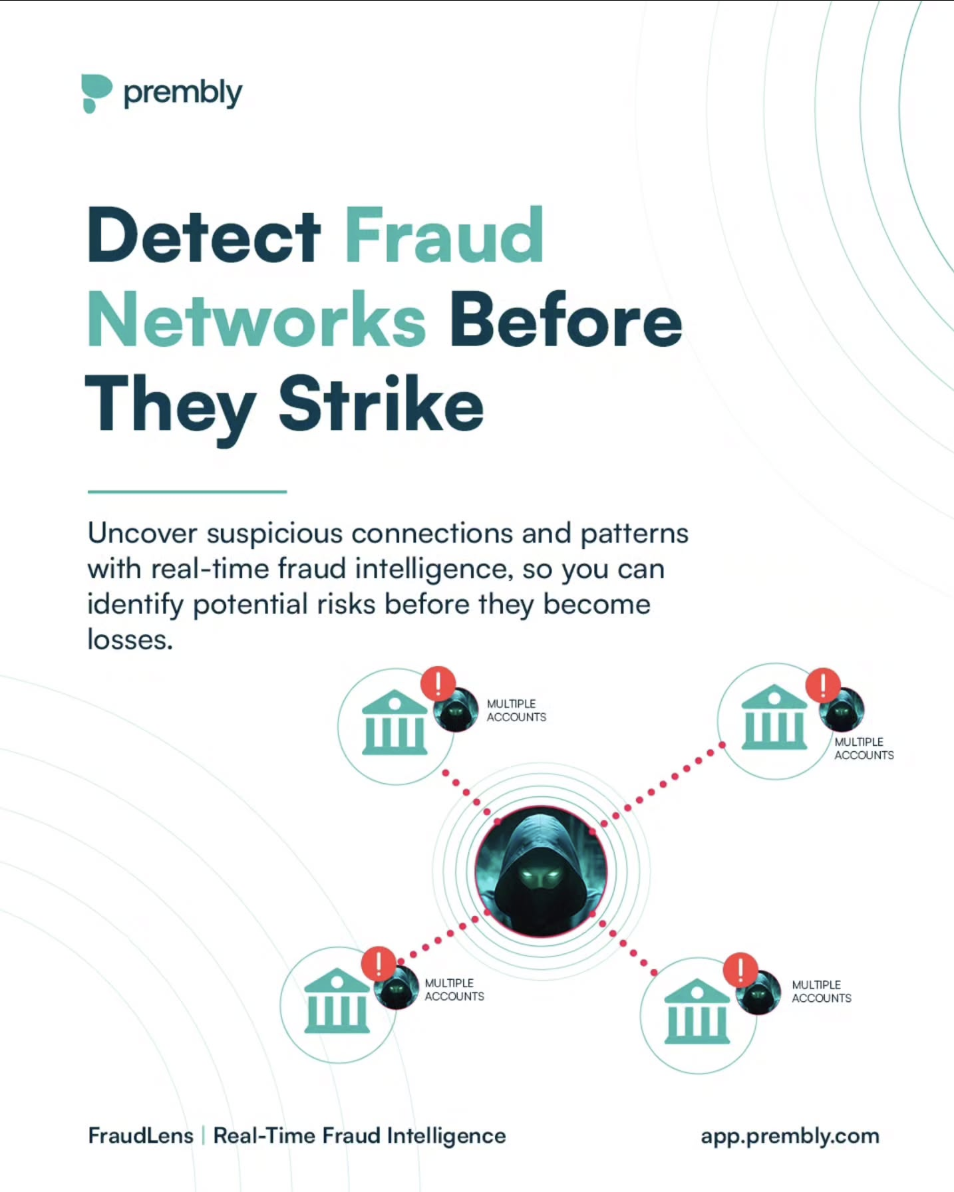
And the company is building what it calls a fraud intelligence-sharing platform.
The idea is particularly interesting.
If Company A discovers that an individual or entity is associated with fraudulent activity, why should Company B have to discover the same thing independently?
Prembly’s proposed “fraud bank” attempts to create a collaborative intelligence layer where businesses can share fraud signals and prevent known bad actors from simply moving from one platform to another.
That creates the possibility of something more powerful than a collection of compliance tools.
It creates a network of trust signals.
And network effects could matter considerably here.
The more businesses participating, the more signals potentially become available.
The more signals available, the better the intelligence.
And better intelligence can make the network more valuable to each participant.
The Numbers Behind the Build
The scale already visible in the business provides some evidence that this is more than an early conceptual infrastructure play.
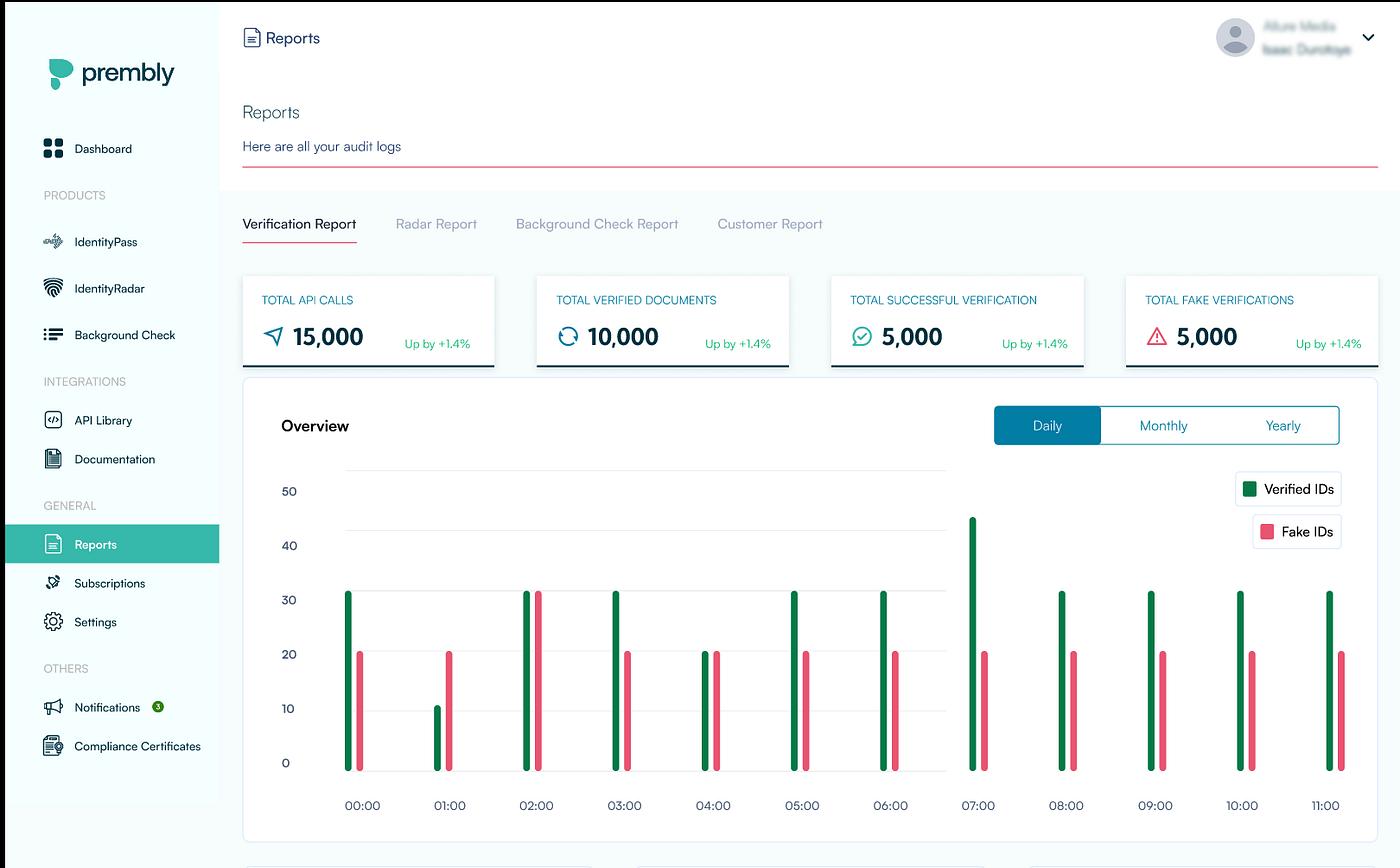
According to the founder, Prembly has processed more than 200 million identity verifications since operations began. It has served more than 7,000 customers and processes millions of transactions through its infrastructure.
Its background-check infrastructure has processed roughly 20 million checks, with customers spanning financial services, healthcare, transportation, energy and other sectors.
The customer base includes organisations such as Mastercard, the London Stock Exchange, Uber, Opay, and Union Bank just to name a few, alongside companies operating across Africa, Europe, North America and other markets.
The significance is not simply the volume.
Every verification, background check and transaction creates another interaction with the trust infrastructure.
That is where the company’s longer-term data thesis becomes interesting.
The AI Layer
Prembly is also adapting to the AI era, but notably without presenting AI as the entire business.
The founder describes AI as something the company has been using to augment its existing infrastructure.
The emerging opportunity is to build agents that can assist businesses with compliance, fraud prevention, financial-crime prevention and internal operational processes.
Prembly’s underlying advantage is not necessarily an AI model.
It is the data and decision environment in which the AI operates.
An AI agent with no reliable trust signals can generate recommendations.
An AI agent connected to years of identity, compliance, fraud and transaction intelligence potentially becomes something more consequential.
Observed Patterns
Prembly sits across technology, compliance, regulation and infrastructure.
The company has repeatedly expanded when the market revealed that the existing layer was insufficient.
Identity verification led to risk management.
Risk management led to enhanced due diligence.
Compliance led to transaction monitoring.
Fraud detection is leading towards shared intelligence.
And shared intelligence creates the possibility of a much broader trust network.
The pattern is not:
“Build more products.”
It is:
Move one layer deeper into the underlying problem.
The founder’s discussion of talent reveals another dimension of building infrastructure from Africa.
He rejects the simplistic idea that African companies simply lack talent.
His argument is more nuanced:
The challenge is often finding the right fit and creating an environment in which people can consistently perform.
He points to practical constraints that are easy to ignore from developed markets: unreliable electricity, connectivity issues and differences in workplace environments.
Prembly’s response has been to create mechanisms that test capability beyond CVs and credentials.
The company has also deliberately used AI to keep its organisation lean while creating pathways for younger workers to gain experience.
That reflects a broader lesson about African startups.
Building globally competitive infrastructure sometimes requires solving the infrastructure around the people building the infrastructure.
Open Variables
The opportunity for Prembly is obvious.
Identity. Compliance. Fraud. Transaction monitoring. Background checks. Data intelligence.AI agents.
Each reinforces the broader trust thesis.
But each also introduces additional operational and regulatory complexity.
The second variable is the data moat.
The founder is clear that proprietary data and algorithms are central to the company’s defensibility.
The question is how strongly those assets compound as Prembly expands across jurisdictions.
The third is the collaborative fraud network.
Fraud intelligence becomes substantially more valuable when many institutions participate.
Building that network requires trust between competitors, regulatory alignment and sufficient incentives to share useful signals.
Whether Prembly can create that network effect remains one of the most interesting parts of the company’s next phase.
Why This Matters
Prembly illustrates an important shift happening in emerging market’s technology.
Some of the most consequential companies may not be building products consumers interact with every day.
They are building the infrastructure that determines whether those interactions can be trusted in the first place.
For fintechs, banks, marketplaces and increasingly AI companies, identity and compliance are not peripheral functions.
They are prerequisites for participation.
That creates a particularly interesting infrastructure opportunity in emerging markets where digital adoption is accelerating while trust systems remain fragmented.
Prembly’s trajectory suggests that the opportunity may be much larger than KYC.
It may be the construction of a trust layer for digital commerce itself.
Final Strategic Takeaway
Prembly started by helping businesses answer a simple question:
“Who is this person?”
It is increasingly trying to help them answer something much harder:
“Can I trust this person, this business, this transaction and this digital interaction?”
That is a much bigger market.
And perhaps the most important lesson from the build is this:
The strongest infrastructure companies do not necessarily own the transaction. They own the intelligence that makes the transaction possible.
This article is drawn from an in-depth founder interview conducted by Afriq IQ with Niyi Adegboye, Co-Founder & COO of Prembly. Selected insights and observations are published here.
Ready to Ace Your Next Funding Pitch?
Join thousands of founders who have improved their pitch skills and secured funding with our automated interview simulator.