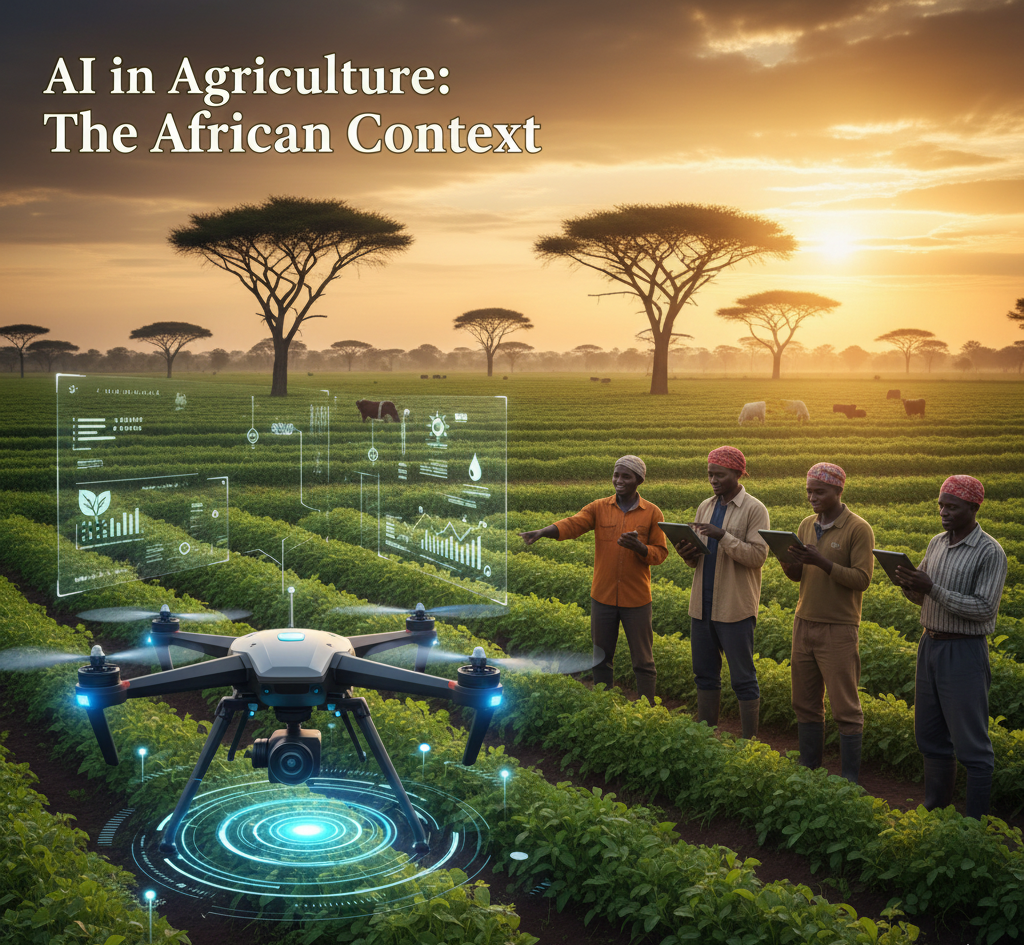
AI in Agriculture: The African Context
Artificial Intelligence (AI) represents one of the most significant technological forces poised to reshape the African agricultural landscape.
Given the acute pressures of climate change, resource constraints, and rising food demand, AI is emerging as a necessity for enhancing efficiency, productivity, and sustainability across the continent.1
The overall African AI market is projected to expand quite dramatically from $4.51 Billion in 2025 to $16.53 Billion by 2030. This reflects a high Compound Annual Growth Rate (CAGR) of 27.42%, according to the payments giant Mastercard.2
Empirical evidence validates AI’s transformative capabilities, particularly for Sub-Saharan Africa’s vast population of smallholder farmers. Case studies show that AI-enabled advisory services and precision tools have achieved yield increases of up to 60% and even 75% for early adopters.3
Simultaneously, these technologies drive critical resource efficiencies, demonstrated by water savings of up to 50% in AI-driven smart irrigation systems.5
The commitment by the African Development Bank (AfDB) and Intel to train 3 million Africans in AI skills 8 represents a vital step toward creating the skilled human capital necessary to drive this technological revolution inclusively.
The Macro Context of AI Adoption in African Agriculture
The Imperative for Agricultural Transformation in Africa
The agri-food systems in Africa are grappling with complex, compounding challenges that necessitate a technological leapfrog.9 Artificial intelligence is emerging as a key driver of this revolutionary technological change.10
The necessity for AI is underscored by three critical forces driving the need for efficiency and resilience across the sector 1: First, global warming necessitates advanced tools for Climate Change and Risk Mitigation. Predictive analytics powered by AI help anticipate increasingly frequent and extreme weather events.1
By improving the ability to predict factors like floods and droughts and optimising land usage, these technologies enhance planning and reduce crop failure risk.11
Second, AI is crucial in Addressing Labor Shortages. Rural-urban migration has reduced the available agricultural workforce, requiring automation and efficient systems that AI can provide.
Automation technologies, such as autonomous tractors and drones, can plant, monitor, and harvest with minimal human intervention, cutting the need for human labour drastically.1
Third, and most fundamentally, AI addresses the widespread Yield and Information Deficit. Many smallholder farmers operate at the very bottom of the yield curve because they lack timely, field-specific agronomic advice.3
Traditional agricultural extension services, where human agronomists visit farms, are effective, capable of doubling or tripling yields, but cost $30–60 per farmer per year, a cost that makes scaling continental coverage impossible.3
AI’s true economic value in this context is its role as a scalable information disruptor, radically collapsing the cost of expert agronomic advice.
For instance, models such as the iSDA Virtual Agronomist deliver site-specific recommendations through a simple chat interface for approximately $1 per farmer per season.3
This democratisation of site-specific knowledge, given the low baseline productivity, allows for immediate, transformative marginal returns, highlighting AI’s strategic significance.
Defining the AI Ecosystem: Precision Farming, Automation, and Advisory Services
The AI ecosystem in agriculture is anchored by precision farming, which held a significant global market share of over 33% in 2024.10
Precision farming utilises sophisticated machine learning algorithms to process high-volume data inputs from multiple sources, including soil sensors, satellite imagery, drones with high-resolution sensors, and weather stations.1
These systems facilitate Real-Time Optimisation, enabling farmers to monitor environmental conditions and make resource allocation suggestions based on exact requirements.10
By doing so, they reduce costs and minimise environmental impact through the efficient application of water, fertilizer, and pesticides.1
For the African context, successful Delivery Mechanisms often leverage low-tech channels, such as chat interfaces or in-person intermediary networks, to avoid common barriers like poor infrastructure and low digital literacy.3
A key observation regarding the labour impact of AI in this context is that AI should be viewed as an economic stabilizer, not a tool for mass job displacement. By improving efficiency and stabilising yields against unpredictable climate risks, AI significantly increases land productivity.11
Higher, more reliable yields naturally necessitate more human labour input in activities such as harvesting, processing, and logistics, effectively supporting rural employment and mitigating some of the effects of rural-urban migration.1
Market Size, Investment Dynamics, and Regional Concentrations
Continental and Global Market Projections
The market forecast for AI adoption across Africa reflects strong investor confidence and recognition of the technology’s high potential for value creation.
As mentioned earlier, the overall African AI market is projected to demonstrate robust growth, moving from $4.51 Billion in 2025 to an estimated $16.53 Billion by 2030.2
This aggressive regional growth trajectory mirrors global trends, where the AI in Agriculture market is forecast to grow from $4.7 Billion in 2024 to $46.6 Billion by 2034, sustained by a CAGR of 26.3%.10
While the Middle East and Africa region shows market size forecasts advancing from $0.20 in 2024 to $0.51 by 2033, driven by digital transformation 14, the African continent itself, with its urgent need for agricultural transformation, is widely seen as the primary engine for future growth in the application layer of AI technology.2
The AgTech Investment Landscape
The foundational growth in AI has been supported by massive increases in broader agri-food tech investment. Private investments in Sub-Saharan Africa (SSA) agri-food tech have soared, rising from less than $10 million in 2014 to approximately $600 million in 2022.1
More recently, 131 AgTech companies raised $215 million across 158 deals over the last year.15 Funding composition is often polarised, with the most common ticket sizes being either very early-stage (below $100,000) or large growth rounds (more than $1 million).15
Analysis of AI-Specific Funding: The Scaling Bottleneck
A critical observation is the emerging structural issue in AI financing: the discrepancy between interest (deal flow) and committed capital (funding volume). In the last twelve months, the number of AI-related deals increased significantly, growing from 9% to 15% of total AgriTech deals.15
This reflects a growing recognition of AI’s potential by founders and early-stage investors. However, despite the surge in deal count, the funding volume dedicated specifically to these AI solutions has been highly constrained, accounting for less than 1% of the total AgriTech funding over the same period.15
This financial imbalance signifies a systemic failure, often referred to as the Growth-Stage Funding Bottleneck, preventing proven AI innovations from scaling. Early-stage ideas attract initial funding, but large investors appear hesitant to commit significant capital for high-risk, growth-stage AI deployments that require extensive infrastructure build-out, data acquisition, and complex team scaling across diverse African supply chains.
Furthermore, the overall funding landscape suffers from high concentration risk, with the top five AgriTechs consistently raising 60–70% of the total funding volume, diverting crucial capital from broader innovation.15
Regional Leadership and Adoption Centers
AI adoption is regionally stratified, leading to concentrated pockets of development. The majority of existing solutions and successful implementation case studies are concentrated in core economies, specifically Kenya, South Africa, and Nigeria.13
Recent trends, however, show diversification. Kenya experienced a notable 45% increase in its share of funding volume.15 Crucially, emerging markets are beginning to gain traction, with Ethiopia, Zambia, and the Democratic Republic of the Congo (DRC) collectively accounting for nearly 10% of recent funding.15
The high concentration of successful solutions in major economies coupled with the capital barriers creates the Threat of Technological Exclusion. If market forces alone dictate adoption, smallholder farmers without access to the necessary networks, hardware, and capital will not benefit.13
This risks larger, tech-enabled operations outpacing smaller farms, which could ultimately endanger rural livelihoods and deepen the existing urban-rural productivity divide.13
Data-Driven Impact of AI Applications on Productivity and Sustainability
Precision Farming and Yield Optimisation
The most compelling justification for promoting AI in agriculture is the quantifiable increase in productivity it delivers by providing customised, timely, and affordable advice.
The iSDA Virtual Agronomist model, which provides site-specific agronomic recommendations through simple low-tech delivery channels, has already served over 250,000 farmers and demonstrated yield increases of up to 60%.3
This substantial return on investment proves that AI’s primary value in Africa lies in its ability to solve the fundamental lack of information, transforming farmer potential into realised output.3
Even higher results have been observed when AI is combined with physical data collection infrastructure. AgriTech Analytics, using AI-powered satellite imagery and solar-powered Internet of Things (IoT) sensors, monitors critical soil metrics (NPK, moisture, fertility, and PH levels).4
Farmers working with this solution saw an average increase in produce by 57% within three to six months, escalating to a 75% increase in harvest after one year.4
This dramatic jump validates AI’s transformative economic potential, particularly for smallholders starting from a low base of soil fertility.3
Enhancing Resource Efficiency and Sustainability
The use of AI is intrinsically linked to sustainable practices by optimising the use of scarce resources.
1. Water Conservation
AI-powered decision support systems utilise machine learning algorithms that process real-time data from IoT sensors, remote sensing, and weather forecasts.12 This allows the systems to predict the optimal time and precise amount of irrigation required.12
Implementation results confirm that AI-driven smart irrigation systems achieve water savings of up to 50% compared to conventional irrigation methods, simultaneously reducing energy costs and supporting climate-resilient farming.5
This ability to achieve high-impact yield increases (up to 75%) alongside significant resource reduction (50% water savings) fundamentally enables sustainable intensification in SSA.4
AI models break the traditional paradigm where yield growth requires linearly increasing inputs, making them the most powerful tools for fostering food security in water-stressed regions.
2. Pest, Disease, and Weed Management
AI contributes substantially to crop protection and environmental health. Machine learning aids the early detection of diseases and pests (observed across crops like cashew, maize, tomato, and cassava) through the analysis of drone or smartphone data.1
This targeted diagnosis enables targeted herbicide and pesticide use, reducing costs and minimising environmental impact.1 Furthermore, AI-powered weeding systems enhance precision and sustainability by automating weed control.
This significantly reduces reliance on broad-spectrum chemical herbicides and lowers labour costs, contributing to improved crop yields and environmental health.17
3. Reducing Financial Risk
Beyond increasing crop output, AI plays a crucial role in providing financial stability via risk reduction. By offering predictive analytics related to weather and pest outbreaks, AI helps stabilise farmer income by reducing the likelihood of catastrophic crop failure.1
This quantifiable reduction in operational and climate risk then facilitates access to crucial financial services like credit and insurance, which traditionally avoid the highly volatile agricultural sector.13
4. Addressing Post-Harvest Loss (PHL)
While specific quantitative results for AI reducing PHL are pending, the potential is vast, given the immense scope of the problem. Sub-Saharan Africa loses up to 50% of fruits and vegetables produced annually 18, with Ghana reporting losses between 30% and 50% across the value chain.18
AI-driven traceability tools and logistics optimisation algorithms are critical future applications for addressing this massive wastage and broadening market access.13
Structural and Socio-Economic Barriers to Inclusive Adoption
The transition from localised success stories to widespread adoption is fundamentally challenged by deep-seated structural barriers related to infrastructure, cost, and human capital.19
The Digital Infrastructure and Data Deficit
The digital divide severely limits the applicability of cloud-based AI tools.19 Only about 40% of Africans are online in 2024, which is far below the 68% global rate.6
This low density of connectivity is exacerbated by geographical disparity: adults in rural areas of SSA are 49% less likely to use mobile internet than those in urban areas.7
For the smallholders who produce the majority of the food, access to real-time data and AI advisory services is highly inconsistent or non-existent.
Beyond connectivity, effective AI implementation requires high-quality data that meets minimum requirements for volume, variety, veracity, and velocity.1
However, the sector suffers from insufficient data availability, inconsistent quality, and fragmented datasets, which directly hinder the development of accurate, localised machine learning models.1
Prohibitive Financial Barriers and Exclusion
For farmers operating on slim profit margins, the high initial investment for AI solutions is a direct deterrent.1 This includes not only the capital required for sensors, equipment, and software 19, but also the cost of personal access devices.
The Affordability Lock-In is quantified by the finding that an entry-level internet-enabled device costs 95% of the average monthly income in Sub-Saharan Africa.7
This single constraint dictates that, for the average smallholder, access to AI-driven services is financially unviable unless radical financial innovations, such as subsidies or microfinance, are introduced.1 Without lowering the cost structure of digital access, subsequent layers of AI technology remain inaccessible.
Compounding this financial issue is pervasive Gender Disparity. Women, who constitute a large portion of the agricultural workforce, are 36% less likely to use mobile internet than men, risking their exclusion from AI-driven productivity gains and exacerbating economic inequality.7
Human Capital and Data Trust Constraints
Limited exposure to digital technologies means many smallholder farmers struggle to operate AI tools or interpret their data outputs, such as predictive analytics.19
Studies confirm this challenge, showing that 69.6% of smallholder farmers expressed a negative perception toward digital technologies, citing cost, skill requirements, lack of knowledge, and perceived difficulty in use.20
Furthermore, existing training programs often lack localisation, and fails to tailor content to local languages, cultures, or specific agricultural contexts.19
Finally, the challenges of data quality and fragmentation are inextricably linked to the Data Trust Deficit. If smallholders fear that data collected by technology providers will be used to their disadvantage, for instance, in predatory lending or land disputes, they will withhold the necessary local data, starving AI models of the granular information needed for accuracy.
To achieve data velocity and veracity, data governance frameworks must prioritise ethical, responsible, and inclusive practices, ensuring farmer-centric data ownership and benefits.1
Policy Frameworks, Partnerships, and Capacity Building
The Strategic Role of Development Finance and International Collaboration
Development Finance Institutions (DFIs) are strategically positioning AI as a critical foundation for Africa’s economic future, underscoring that AI is “not a luxury, it’s a necessity for Africa’s competitiveness, resilience, and long-term prosperity”.9
The African Development Bank (AfDB) emphasizes the critical need to invest in youth and data infrastructure as the foundational pillars for building Africa’s AI future.9
Collaborative efforts, such as the AfDB’s co-hosting of events with Google AI Research, highlight the continent’s commitment to leveraging global expertise to overcome structural agricultural challenges.9
Capacity Building and Human Capital Development
Addressing the severe skill deficit is essential to transition the continent from being technology consumers to technology contributors.
The African Development Bank and Intel have formalised a landmark cooperation initiative aimed at equipping 3 million Africans and 30,000 government officials with AI skills.8
This initiative is explicitly designed to address socio-economic challenges and boost productivity in key growth sectors, including agriculture, health, and education, thereby ensuring Africans are contributors to the Fourth Industrial Revolution (4IR).8
The sheer scale of this training initiative represents a strategic effort toward shifting from consumption to contribution.
By cultivating a massive indigenous talent pool, the strategy ensures that future AI solutions are engineered to fit African realities, specific crop conditions, and localised environmental constraints, thereby solving the problem of scarcity of locally relevant support and training resources.19
Establishing Robust Governance and Ethical AI Guidelines
Parallel to capacity building, the development of robust policy is crucial for de-risking continental investment and ensuring inclusive scaling.
The AfDB-Intel partnership includes vital support for African countries in developing harmonised policy and regulatory frameworks covering AI, 5G, Wi-Fi 6E, data, and cloud infrastructure.8
This focus on harmonised frameworks is critical for governance as an investment enabler. Standardised rules reduce regulatory fragmentation, allowing AgriTech solutions to scale more efficiently across regional economic communities and making the realisation of the high market growth potential more feasible.2
Furthermore, policy must prioritise ethical and responsible AI practices, integrating considerations for gender equality, social inclusion, and environmental sustainability during development and deployment.16
Co-creation with local farmers ensures that the technology remains relevant and enjoys the social license necessary for long-term adoption.16
Conclusion
Synthesis of Key Findings
AI offers a transformative, high-impact solution to Africa’s agricultural challenges, delivering proven yield gains up to 75% and resource efficiency (50% water savings).3 The overall market trajectory for AI in Africa is extremely positive, forecasting a CAGR of 27.42% through 2030.2
However, the analysis identifies three critical inhibitors:
Financial Exclusion: The cost of entry-level devices is prohibitive, representing 95% of average monthly income.7
Digital Divide: The urban-rural connectivity gap remains vast, with rural adults 49% less likely to use mobile internet.7
Scaling Gap: Early-stage AI ventures struggle to secure growth funding, as evidenced by AI deals representing 15% of transactions but less than 1% of total funding volume.15
Addressing these structural barriers is a prerequisite for ensuring that technological progress is inclusive and benefits the smallholder farmers who form the backbone of the continent’s food security.
Strategic Recommendations for Inclusive Scalability
The following actions are necessary to maximise the economic and environmental benefits of AI in African agriculture:
- De-risk Digital Access through Subsidy and Finance: Introduce public-private financing models, such as microfinance or targeted government subsidies, to fundamentally lower the cost of entry-level smart devices and sensors for rural populations.1 This directly addresses the 95% affordability barrier.7
- Focus on Low-Connectivity Solutions: Prioritise investment in AI systems designed to operate effectively with intermittent or low-bandwidth connectivity, leveraging feature phones or simple SMS interfaces (like the iSDA model) to bypass the need for ubiquitous high-speed internet.3
- Accelerate Policy Harmonisation: Governments and regional bodies must expedite the development of unified, harmonised regulatory frameworks for data, connectivity (5G, Wi-Fi 6E), and ethical AI deployment.8 This is crucial for reducing regulatory risk and allowing AgriTech solutions to scale continentally.
- Localise Capacity Building and Support: Leverage the momentum of major training initiatives, such as the AfDB-Intel program 8, but ensure delivery is localised and utilises trusted intermediaries, like extension officers, to overcome skill gaps and negative perceptions among smallholders.19
Quantitative Data for Graphical Representation
Table 1: African AI Market and AgriTech Growth Projections
|
Metric |
Base Year (2024/2025) |
Forecast Year (2030/2034) |
Compound Annual Growth Rate (CAGR) |
Source Context |
|
African AI Market Size (USD) |
$4.51 Billion (2025) |
$16.53 Billion (2030) |
27.42% |
Mastercard Report (Africa) 2 |
|
Global AI in Agriculture Market Size (USD) |
$4.7 Billion (2024) |
$46.6 Billion (2034) |
26.3% |
Global Insights 10 |
|
SSA Agri-Food Tech Investment Volume (USD) |
<$10 Million (2014) |
~$600 Million (2022) |
N/A |
World Bank/Private Investment 1 |
|
AI Share of AgriTech Deals (Percentage) |
9% (Previous 12 Months) |
15% (Latest 12 Months) |
N/A |
Briter Report 15 |
Table 2: Quantified Impact of AI on African Farm Productivity and Efficiency
|
Application Area |
Specific Metric |
Reported Impact |
Region/Context |
|
Yield Enhancement (Advisory) |
Crop Yield Increase |
Up to 60% |
iSDA Virtual Agronomist (Low-cost advice) |
|
Yield Enhancement (IoT/Analytics) |
Crop Harvest Increase (1 Year) |
75% |
AgriTech Analytics (IoT/Satellite Data) |
|
Resource Efficiency |
Water Usage Reduction |
Up to 50% |
AI-Powered Smart Irrigation Systems |
|
Post-Harvest Loss (PHL) |
SSA Fruits/Vegetables PHL |
Up to 50% |
Global/Regional Estimate |
Table 3: Key Structural Barriers and Human Capital Response in SSA
|
Barrier Category |
Specific Metric |
Quantified Impact |
Source Context |
|
Digital Connectivity |
Africans Online Penetration |
38% (vs. 68% Global Rate) |
Ecofin Agency 6 |
|
Digital Divide (Rural/Urban) |
Likelihood of Mobile Internet Use (Rural vs. Urban) |
49% Less Likely (Rural) |
GSMA (Sub-Saharan Africa) 7 |
|
Affordability |
Cost of Entry-Level Device |
95% of Average Monthly Income |
GSMA (Sub-Saharan Africa) 7 |
|
Capacity Building |
AfDB/Intel Training Target (Africans) |
3 Million |
AfDB Partnership |
References
- Is Artificial Intelligence the future of farming? Exploring opportunities and challenges in Sub-Saharan Africa – World Bank Blogs, https://blogs.worldbank.org/en/agfood/artificial-interlligence-in-the-future-of-sub-saharan-africa-far
- Africa’s AI Market Poised to Reach $16.5 Billion by 2030, Mastercard …, https://www.ecofinagency.com/news-digital/1308-48038-africa-s-ai-market-poised-to-reach-16-5-billion-by-2030-mastercard-reports
- Changing the Yield Curve: How Smarter, AI-Powered Advice Can Transform African Farming – Isda-africa.com, https://www.isda-africa.com/posts/changing-the-yield-curve/
- Climate Adaptation Solutions: Improving Farmers’ Yields using AI and Internet of Things devices, https://gca.org/video/climate-adaptation-solutions-improving-farmers-yields-using-ai-and-internet-of-things-devices/
- Optimizing Water Resource Management in Agriculture Using AI-Powered Solar Irrigation Systems – African Scholar Publications, https://africanscholarpub.com/ajsitr/article/download/530/513/1012
- Africa’s Internet Growth Outpaces World, but Gaps in Access Remain Deep – Ecofin Agency, https://www.ecofinagency.com/news-digital/0506-47164-africa-s-internet-growth-outpaces-world-but-gaps-in-access-remain-deep
- Despite improvements, Sub-Saharan Africa has the widest usage and coverage gaps worldwide | Mobile for Development – GSMA, https://www.gsma.com/solutions-and-impact/connectivity-for-good/mobile-for-development/blog/despite-improvements-sub-saharan-africa-has-the-widest-usage-and-coverage-gaps-worldwide/
- Digital Future for Africa: African Development Bank and Intel to Train Millions in AI, https://www.afdb.org/en/news-and-events/press-releases/digital-future-africa-african-development-bank-and-intel-train-millions-ai-71649
- From Strategy to Action: African Development Bank and Google Explore Africa’s AI Future at the 2025 Annual Meetings, https://www.afdb.org/en/news-and-events/strategy-action-african-development-bank-and-google-explore-africas-ai-future-2025-annual-meetings-84722
- AI in Agriculture Market Size & Share, Growth Report 2025-2034, https://www.gminsights.com/industry-analysis/ai-in-agriculture-market
- Road map for research on responsible artificial intelligence for development (AI4D) in African countries: The case study of agriculture – PMC – PubMed Central, https://pmc.ncbi.nlm.nih.gov/articles/PMC8672141/
- Harnessing Digital Technologies for Smarter Water Management in Agriculture – World Economic Forum: Publications, https://reports.weforum.org/docs/WEF_Harnessing_Digital_Technologies_for_Smarter_Water_Management_in_Agriculture_2025.pdf
- How AI can inclusively transform agri-food systems in Africa – Brookings Institution, https://www.brookings.edu/articles/how-ai-can-inclusively-transform-agri-food-systems-in-africa/
- Ai In Africa Market Size, Share, Industry Trends and Forecast to 2033 – Consainsights, https://www.consainsights.com/reports/ai-in-africa-market
- State of AgTech Investment in Africa 2024 on Briter (formerly Briter …, https://www.briter.co/insights/reports/state-of-agtech-investment-in-africa-2024
- Enhancing Africa’s agriculture and food systems through … – PubMed, https://pubmed.ncbi.nlm.nih.gov/39917548/
- How Artificial Intelligence (AI)-Powered Weeding Is Transforming Africa’s Agricultural Future, https://www.nepad.org/blog/how-artificial-intelligence-ai-powered-weeding-transforming-africas-agricultural-future
- Study protocol: post-harvest losses of fruits and vegetables and their relationship with the nutritional status of women and children – PMC – NIH, https://pmc.ncbi.nlm.nih.gov/articles/PMC12490541/
- (PDF) Challenges of AI Adoption in Smallholder Farming …, https://www.researchgate.net/publication/392785592_Challenges_of_AI_Adoption_in_Smallholder_Farming_Infrastructure_Cost_and_Digital_Literacy
- Awareness and Perception of Digital Technologies by Smallholder Farmers in the Eastern Cape Province, South Africa, https://sajae.co.za/article/view/16200