Artificial Intelligence in African Logistics
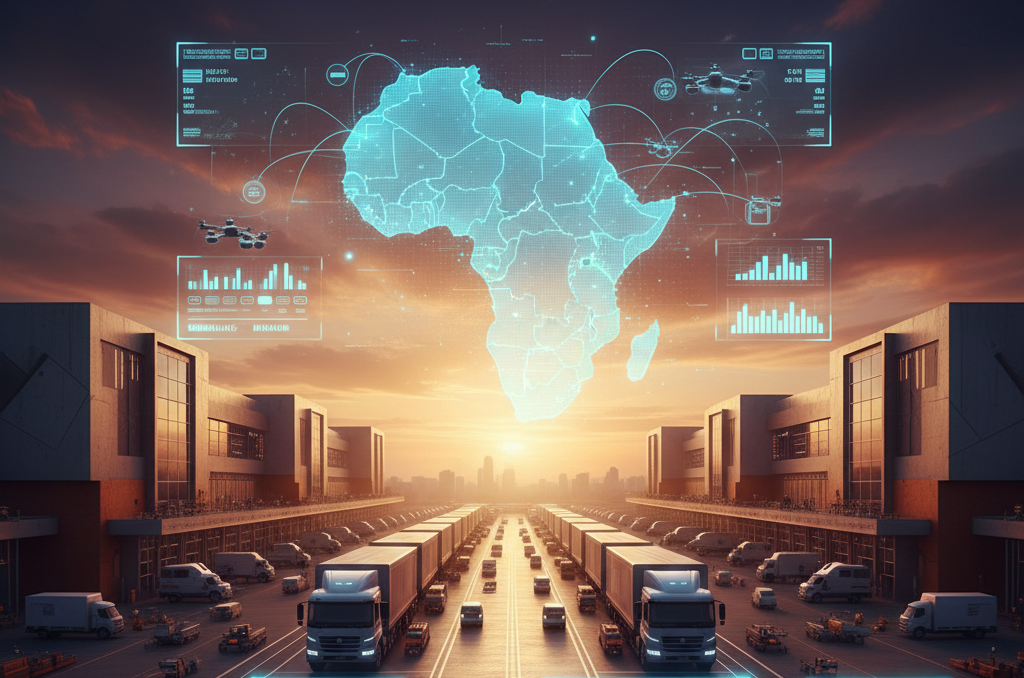
The convergence of rapid technological adoption and profound continental trade reforms positions Artificial Intelligence (AI) as the most critical driver for modernising African logistics.
The logistics sector across the Middle East and Africa (MEA) is projected to expand significantly, growing from an estimated USD 305.07 Billion in 2025 to USD 400.99 Billion by 2030, representing a stable 5.62% Compound Annual Growth Rate (CAGR).1
However, the AI market is undergoing structural acceleration at an even faster pace, anticipated to grow from US$4.51 billion in 2025 to approximately US$16.53 billion by 2030, reflecting a substantial 27.4% CAGR.2
This disparity signals a determined technological disruption aimed at unlocking the massive trapped economic value currently lost to supply chain inefficiencies.
AI serves primarily as a resilience multiplier, delivering performance gains that exceed global norms due to the high baseline of inefficiency it addresses.
This transformation yields quantifiable metrics such as a 30% reduction in delivery times achieved by startups in West Africa 3 and dramatic policy-driven efficiency improvements, exemplified by the reduction of cargo transit time on the Mombasa-Kampala corridor from 18 days to just three days.4
Despite this rapid progress, scaling AI deployment is hindered by two major structural factors. First, investment remains highly concentrated, with Nigeria, Kenya, South Africa, and Egypt, the “Big Four”, receiving approximately 83% of AI startup funding.2
Second, foundational infrastructure gaps persist, including high connectivity costs, where 1 GB of mobile data costs the average user in Africa nearly nine percent of their average monthly income 5, and a critical shortage of hybrid professionals who possess both technological fluency and sectoral expertise.6
The strategic imperative for the period spanning 2025 to 2035 involves bridging these gaps. Success requires coordinated government mandates for data harmonisation (essential for the African Continental Free Trade Area, AfCFTA) and sustained Development Finance Institution (DFI) and corporate investment in localised, reliable computing infrastructure.
This demand is quantified by the projected growth of IT load capacity in African data centres at a remarkable 24.29% CAGR.7 Only through this synergistic approach, combining policy, technology, and capital, can Africa transform its logistical challenges into a dynamic global competitive advantage.
Strategic Context and Market Foundations
The African Logistics Market: Size, Segmentation, and Growth Drivers
The African logistics market is a foundational economic sector defined by significant scale and regional heterogeneity. The overall Middle East and Africa (MEA) freight and logistics market provide a robust economic environment for technological investment, demonstrating stability and sustained expansion.
The market is forecasted to grow from an estimated USD 305.07 Billion in 2025 to USD 400.99 Billion by 2030, sustained by a healthy 5.62% CAGR during that forecast period.1
Regional analysis reveals that growth rates are substantial but vary based on localised infrastructure development and economic maturity. South Africa, a regional powerhouse, leads in both scale and acceleration, expected to generate a revenue of USD 137.4 billion by 2030, growing at an impressive 6.8% CAGR from 2025.8
Simultaneously, the East Africa Logistics Market is set for expansion, projected to reach USD 36.8 Billion by 2033 with a 4.92% CAGR from its 2024 valuation of USD 23.9 Billion.9 These figures underscore the vast, expanding addressable market for technologically advanced logistics solutions.
From a functional segmentation standpoint, freight transport remains the dominant component, commanding 59.66% of the Middle East and Africa freight and logistics market share in 2024.1
This dominance indicates that AI applications focused on high-volume logistics functions—such as optimising road freight networks, maritime scheduling, and real-time tracking—offer the highest initial leverage points for injecting efficiency and generating measurable returns on investment.
Table 1: African Logistics Market Size and Growth Projections
Region/Country | Market Size (2024/2025 Est.) (USD Billion) | Forecast Size (2030/2033) (USD Billion) | Compound Annual Growth Rate (CAGR) | Source Citation |
Middle East & Africa (Freight) | $305.07 Billion (2025) | $400.99 Billion (2030) | 5.62% (2025–2030) | 1 |
South Africa (Logistics Market) | $92.7 Billion (2024) | $137.4 Billion (2030) | 6.8% (2025–2030) | 8 |
East Africa (Logistics Market) | $23.9 Billion (2024) | $36.8 Billion (2033) | 4.92% (2025–2033) | 9 |
South Africa (Freight & Logistics) | $14.70 Billion (2025) | $19.90 Billion (2030) | 6.24% (2025–2030) | 10 |
The Digital Imperative: AI as a Resilience Multiplier
African supply chains historically face immense frictional costs, often driven by fragmentation, unpredictable infrastructure, and complex regulatory environments.
Operational costs can consume up to 75% of the final product price 3, making the status quo unsustainable for fostering continent-wide industrialisation. AI’s value proposition in this context transcends simple cost-cutting; it acts as a necessary resilience multiplier.
In contrast to mature markets where AI offers incremental optimisation (typically 5-10% gains), AI deployment in Africa yields dramatic, quantified improvements.
This technological impact is rooted in AI’s ability to compensate for significant, systematic deficiencies unique to the continent, such as unreliable infrastructure data and frequent, unpredictable disruptions like power outages or unexpected traffic.3
The success of predictive analytics, machine learning for smart routing 12, and Generative AI (Gen AI) for back-office automation 13 stems from their capacity to provide real-time adaptability in chaotic operational environments.
The high measured efficiency gains – such as the 30% reduction in delivery times observed in West Africa 3 , are only achievable when the underlying operational baseline is fraught with systematic friction.
AI’s ability to process vast, disparate datasets and automate dispatch decisions in real time fundamentally mitigates risks and delays that a human scheduler or traditional logistics system cannot address effectively.
Consequently, the technology is viewed not as a luxury for optimisation but as an essential tool for ensuring operational continuity and predictability.
The Catalytic Role of AfCFTA and Policy Drivers
The African Continental Free Trade Area (AfCFTA) represents the single greatest structural catalyst driving demand for intelligent logistics systems. Full implementation of the AfCFTA Agreement is expected to increase intra-African freight demand by a dramatic 28% and demand for maritime freight by 62%.4
This surge in volume necessitates an interoperable, digitally visible, and highly efficient continental logistics network.
Crucially, the greatest efficiency gains are realised when policy reform precedes or complements technological investment. The successful policy changes within the East African Community (EAC) serve as a potent example.
These reforms, alongside infrastructure and digital investments, resulted in the time required to move cargo from Mombasa to Kampala being cut from 18 days to three days, while the cost of transport from Mombasa to Nairobi was reduced by 56%.4
This reduction demonstrates that policy mandates for data sharing, streamlined customs, and infrastructure prioritisation are the non-negotiable prerequisites for maximising AI’s potential.
However, the expansion of the AfCFTA is threatened by the highly concentrated nature of AI capital. Approximately 83% of AI startup funding in early 2025 flowed into just four major economic hubs: Nigeria, Kenya, South Africa, and Egypt.2
This concentration of advanced logistics technology risks creating significant technological disparities across the continent.
If the AI-driven solutions necessary for streamlined customs, predictive maintenance, and cross-border payment systems are only optimised and readily accessible in these “Big Four” economies, less capitalised and digitised regions may face competitive and administrative disadvantages.
This outcome could effectively establish technological ‘hard borders,’ undermining the goal of seamless digital visibility and interoperability required to realise the full 28% expansion of intra-African trade.12
Overcoming this structural imbalance requires a deliberate, continent-wide strategy for AI democratisation and infrastructure equity.
Quantification of AI Adoption and Investment Landscape
The Exponential Trajectory of African AI Investment
A particularly fast-growing subset of AI in Africa is Generative AI (Gen AI) software applications. Logistics firms are increasingly relying on Gen AI for automation and predictive capabilities.13
The software market share within the logistics technology sphere is expected to grow at a CAGR exceeding 32% during the forecast period.13 This preference is driven by the fact that Gen AI applications, particularly cloud-native solutions, offer superior scalability and are inherently cheaper to maintain over time compared to relying on external human experts.13
Furthermore, these systems operate continuously, processing queries day and night, thereby institutionalising efficiency and reducing reliance on human analysts for routine chores.13
Despite this aggressive internal expansion, the African AI market’s participation in the global technology ecosystem remains modest, accounting for only 1–1.5% of total global AI spending.2
This quantifiable gap signifies that while growth is accelerating dramatically, the market has not yet reached maturity, leaving tremendous white space for new entrants and sustained, large-scale investment.
Investment Concentration and Regional Dynamics
The distribution of AI investment across Africa presents a dual narrative of promise and risk. While overall funding grows, capital remains highly clustered around established technology hubs.
The most significant structural risk facing the digital transformation of African logistics is the overwhelming investment concentration in the “Big Four” markets: Nigeria, Kenya, South Africa, and Egypt. These four nations collectively received approximately 83% of AI startup funding in early 2025.2
Regionally, Sub-Saharan Africa (SSA) currently leads the capital deployment, attracting 60–65% of total AI investment. This trend is fuelled primarily by robust mobile-first financial technology, high urbanisation rates, and a strong grassroots startup culture.
North Africa secures the remaining 20–25%, benefiting from established links to European markets, stronger urban infrastructure, and early digital-government initiatives.2
Specialised logistics platforms successfully leveraging this funding demonstrate the tangible outcomes of AI investment. Ridelink, an AI-powered logistics and trade-infrastructure company operating in Uganda, recently announced the final close of an oversubscribed $1.1 million pre-seed round.14
The investment, which included participation from global entities like Morgan Stanley Inclusive & Sustainable Ventures and the Google Black Founders Fund, reinforces the potential of AI-driven logistics marketplaces.14
Ridelink’s ‘Adrian AI’ intelligence layer provides predictive pricing, smart matching, and route optimisation capabilities, showcasing how technology is deployed to solve complex logistical inefficiencies that cost frontier economies over $150 billion annually.14
Venture Capital (VC) and Development Finance Institution (DFI) Flows
The investment landscape for African logistics technology exhibits inherent volatility, requiring strategic capital intervention to ensure sustainable development. Investment in the sector peaked at $623 million in 2022, but this was followed by a sharp drop and significant instability throughout the subsequent years.
Funding fluctuated dramatically, surging to $220.6 million in the first half of 2024 before falling again to just $113.7 million in the first half of 2025.16
This pronounced volatility highlights a critical capital requirement for the sector. Venture Capital (VC) tends to be risk-on capital seeking rapid, scalable growth, which often clashes with the long-term, capital-intensive nature of logistics infrastructure and supply chain technology.
When speculative VC funding recedes, as demonstrated by the sharp drop in 2023-2025 figures, projects crucial for digitising foundational infrastructure risk stalling.
Therefore, a necessary strategic shift is occurring where more stable capital sources, particularly Development Finance Institutions (DFIs) and large corporate investors, must fill this funding vacuum to sustain momentum in infrastructure-aligned solutions.17
DFIs are increasingly recognising the necessity of investing in digital infrastructure to support critical supply chains. For instance, the Development Finance Corporation (DFC) is active in financing infrastructure and telecommunications to facilitate long-term economic growth.17
The DFC provided a $5 million loan to help QuantumID Technologies expand its SmartKargo e-commerce and logistics platform in Senegal.17
This type of strategic, non-volatile investment is essential for bolstering secure digital infrastructure, countering risks associated with geopolitical competition, and ensuring the long-term digital architecture of African supply chains.17
AI Applications and Operational Impact
The deployment of AI across African logistics is translating into measurable, dramatic improvements in operational performance, particularly in high-friction areas such as last-mile delivery, port management, and cross-border compliance.
Intelligent Fleet and Last-Mile Optimisation
Last-mile delivery in Africa is characterised by unique challenges, including unreliable secondary road networks, poor addressing systems, and unpredictable traffic patterns. AI-powered route optimisation engines provide a sophisticated mechanism to overcome these systemic challenges.
These advanced systems consider over 200 constraint parameters, including traffic conditions, vehicle capacities, delivery time windows, and road restrictions, to generate real-time optimal routes that minimise both costs and travel distance.11
The impact of this technology is highly quantifiable across key performance indicators (KPIs):
- Delivery Time and Cost Reduction: Leta.ai in West Africa achieved a verified 30% reduction in delivery times by leveraging predictive analytics and automated dispatch decisions.3 Simultaneously, general route optimisation services are aimed at reducing last-mile delivery costs by up to 14%.11
- Vehicle Utilisation: Optimization drives significant volume efficiency, enabling businesses to achieve up to 25% more deliveries per vehicle and increasing delivery schedule adherence by up to 20%.11
- Yield Improvement: Within major logistics hubs, the results are equally compelling. Imperial Logistics in South Africa utilised AI routing to boost its operational yields by 22%.19 Separately, digital hubs employed by Jumia in Nigeria were instrumental in cutting delivery times by 40%, demonstrating the impact of integrated digital systems.19
Beyond simply identifying the fastest route, AI acts as a critical maintenance predictor. The systems predict vehicle maintenance needs, helping operators avoid unexpected breakdowns that could disrupt operations and lead to costly delays.3
In a supply chain environment where the availability of parts and swift mechanical repairs is often challenging, maximising vehicle uptime through predictive diagnostics is a vital strategic function that directly minimises operational risk and ensures consistent service delivery.
Table 2: Quantifiable Efficiency Gains from AI in African Logistics.
AI Application/Startup | Region/Focus | Key Efficiency Metric | Quantified Improvement | Source Citation |
Predictive Analytics (Leta.ai) | West Africa (Delivery) | Reduction in Delivery Times | 30% reduction | 3 |
E-commerce Digitization (Jumia) | Nigeria | Delivery Time Cut | 40% reduction | 19 |
AI Route Optimization (Imperial Logistics) | South Africa | Yield Optimization | 22% boost | 19 |
AI Route Optimization (General) | Last-Mile Delivery | Deliveries Per Vehicle | Up to 25% increase | 11 |
Policy/Tech Reform (EAC) | Mombasa-Kampala Corridor | Cargo Transit Time Reduction | From 18 days to 3 days (83% reduction) | 4 |
Policy/Tech Reform (Egypt ACI) | Customs Clearance | Time Reduction Goal | From 8 days to 48 hours (75% reduction) | 20 |
AI Route Optimization (General) | Last-Mile Delivery | Reduction in Delivery Cost | Up to 14% reduction | 11 |
Smart Port and Maritime Operations
African maritime trade is essential for global integration, with total trade amounting to 1.3 billion tons in 2021.21 AI is rapidly being deployed in port operations to mitigate chronic congestion and improve vessel turnaround times, a particular concern in South Africa following supply chain disruptions linked to port strikes.12
Key AI technologies transforming ports include:
- Smart Port Management & Automation: AI systems enable predictive maintenance by analysing sensor data to forecast equipment failures, minimising unexpected downtime and reducing maintenance costs.22 Advanced automation is also used for enhancing the efficiency of loading and unloading containers.22
- Digital Twin Technology: AI creates digital replicas of port layouts and operations, allowing managers to simulate scenarios, optimise traffic flow, and improve overall efficiency before physical deployment.22
- Supply Chain Optimisation: AI-driven demand forecasting predicts cargo volume trends, which helps port authorities manage resources effectively and avoid congestion during peak periods.22
Furthermore, AI is instrumental in meeting international Environmental, Social, and Governance (ESG) standards. AI tracks and reduces carbon emissions from ships and port activities and optimises energy consumption within port facilities.22
Given that Liberia, an African nation, is the world’s largest flag state of registration in terms of dead weight tonnage as of 2022 4, these AI applications are not merely for local efficiency but are crucial for ensuring compliance and maintaining competitive positioning within the global maritime industry, especially concerning international emission standards.21
Customs, Trade Facilitation, and Compliance Automation
One of the most significant friction points in African logistics is the administrative burden of cross-border and customs procedures. AI offers a powerful solution by streamlining the documentation layer of trade.
Freight operators are utilizing AI capabilities such as Optical Character Recognition (OCR) and large language models to accurately extract and verify critical details from waybills, bills of lading, and customs declarations.23 This automation drastically cuts down on manual processing time, reduces error rates, and improves compliance.24
The institutional impact of AI-enabled systems is best exemplified by Egypt’s implementation of the Advance Customs Information (ACI) system.
This move includes introducing an updated risk management system and implementing AI technologies in customs inspections, with the explicit goal of cutting customs clearance time from eight days down to just 48 hours.20 This represents a potential 75% efficiency gain at a high-leverage point in the supply chain.
Beyond physical movement and clearance, AI supports essential trade finance and risk assessment functions. Machine learning tools allow banks and insurers to evaluate logistics data in real-time.
This provides immediate, data-driven insights into shipment risk and creditworthiness, ultimately reducing the cost of credit for Small and Medium Enterprises (SMEs) engaged in regional trade and strengthening Africa’s internal market dynamics.12
The Friction Points
The widespread adoption of AI in African logistics is currently constrained by three primary structural impediments: unreliable digital and physical infrastructure, fragmented data ecosystems, and a critical human capital deficit.
Digital Infrastructure and Reliability Constraints
Real-time, data-driven AI systems require ubiquitous and affordable connectivity, which remains a substantial hurdle across the continent. The cost of connectivity presents a major affordability barrier for logistics operators, particularly those involved in last-mile delivery and telematics implementation.
Data shows that 1 GB of mobile data costs the average user in Africa nearly nine percent of their average monthly income.5 This prohibitive cost severely limits the proliferation of Internet of Things (IoT) sensors and distributed data collection necessary for fleet management and advanced route optimisation.11
To counteract high latency and connectivity costs, there is a pronounced strategic pivot toward localised computing infrastructure. The African data centre market is experiencing high investment, with IT load capacity projected to grow at a 24.29% CAGR, expanding from 1.17 thousand megawatt in 2025 to 3.46 thousand megawatt by 2030.7
This accelerated growth in localised data centres, particularly in hubs like Lagos, Nairobi, Cairo, and Johannesburg 25, serves as a direct, necessary counter-strategy to distance and latency issues, ensuring real-time AI processing capabilities.
However, the power supply remains a fundamental challenge for maintaining continuous AI operations. Artificial intelligence systems, particularly those relying on Gen AI, require high uptime, often processing data continuously.13
Unreliable power supply and grid constraints pose a significant threat to data centre stability and real-time operations.26
Consequently, successful operators are increasingly those who can bundle renewable power solutions to guarantee continuity, demonstrating that the true operational cost of reliable AI in Africa is heavily indexed to energy security and redundancy, which favours organisations capable of navigating grid instability.7
Data Scarcity, Quality, and Fragmentation
Effective AI models are wholly dependent on large volumes of high-quality, structured data. African organisations face endemic difficulties with poorly integrated data sources and a persistent lack of reliable, clean data needed to train robust machine learning models.26
Furthermore, across many regional logistics networks, the digitalisation of supply chains remains minimal, restricting access to the structured datasets required for sophisticated predictive analytics and demand forecasting.26
The condition of physical infrastructure compounds the data challenge. While certain nations boast relatively high road quality scores (e.g., Namibia at 5.2, South Africa at 5.0, and Rwanda at 5.0 out of 7 28), much of the secondary road infrastructure is unpredictable and poorly maintained.
This mandates the need for highly advanced geocoding, address cleaning, and dynamic real-time re-routing to accurately predict Estimated Times of Arrival (ETAs) and optimise routes.11
The success of AI in last-mile delivery is therefore directly correlated with its ability to reliably process and model the uncertainties created by poor transport networks.26
The AI Skills Deficit and Human Capital Gap
The most pressing human capital constraint is not merely a shortage of core AI researchers or developers, but a deficit of hybrid professionals—individuals who possess both logistics domain expertise and technological fluency.6
The modern supply chain demands leaders proficient in advanced technologies like AI demand prediction and IoT tracking.29 Without this specialised workforce, technological implementation stalls.
The rising urgency of this need is quantified in key markets. In South Africa, the Education sector saw the largest increase in job postings requiring AI skills, surging from 4.9% in 2021 to 8.5% in 2024.30
The Information and Communication Technology (ICT) sector followed closely, with AI skill demand rising from 5.5% to 7.9% over the same period.30 This demonstrable market demand highlights the recognised necessity for specialised skills.
Addressing this gap requires shifting focus toward upskilling existing supply chain professionals into roles such as logistics data analysts and AI product strategists.6
Prioritising the training of incumbent logistics managers in data interpretation and systems thinking allows for the rapid integration and effective management of AI systems, potentially accelerating capacity building faster than relying solely on the creation of entirely new talent pipelines.29
Table 3: Benchmarks of Digital Infrastructure and Human Capital Constraints.
Infrastructure/Talent Metric | Key African Challenge | Data/Metric | Source Citation |
AI Market Growth vs. Global Share | Africa’s modest role in global AI scale | 1% to 1.5% of total global AI spending | 2 |
Connectivity Affordability | Burden on the end-user/last-mile operator | 1 GB Mobile Data costs nearly 9% of average monthly income | 5 |
IT Load Capacity Growth (Data Centers) | Indicator of computational readiness for AI | 24.29% CAGR (2025–2030) in IT Load MW | 7 |
South Africa AI Skills Demand | Education sector job postings requiring AI skills | 4.9% (2021) to 8.5% (2024) | 30 |
Road Quality Index (Leading African Nations) | Indicator of physical infrastructure reliability | Namibia (5.2), South Africa (5.0), Rwanda (5.0) score (1-7 scale) | 28 |
Policy Momentum
National AI Strategies and Enabling Environments
African governments and regional bodies are actively developing strategic frameworks to capitalise on AI. The African Union (AU) Continental AI Strategy is designed to align with Agenda 2063 and the Sustainable Development Goals (SDGs), prioritising the development and adaptation of AI systems to the specific African context while adhering to principles of ethics and inclusion.31
Several nations have established detailed agendas:
- Kenya: The government is focused on expanding foundational digital infrastructure through the Digital Superhighway Project, which aims to lay 100,000 kilometres of fibre optic cable.32
Furthermore, policy flexibility is demonstrated by the repeal of the 30% domestic equity requirement for technology companies, a move that removed a significant barrier and attracted major foreign investment, such as AWS, which is essential for scaling AI infrastructure.32
- South Africa: The national plan targets the implementation of AI for predictive maintenance, diagnostic abilities, and logistics optimisation, aiming to develop a competitive edge in technology-driven solutions, particularly in strategic sectors like mining and manufacturing.22
- Nigeria: The draft National AI Strategy (NAIS) recognises the strategic undertaking required to develop a robust AI ecosystem and prioritises foundational policy reforms, particularly improving public education and establishing a robust data ecosystem.34
The Importance of Regulatory Harmonisation
The analysis demonstrates that the most substantial logistical gains in Africa are realised not through technology in isolation, but through institutional reform that enables technology adoption.
The dramatic 83% time reduction on the Mombasa-Kampala trade corridor 4 and Egypt’s goal of achieving a 75% cut in customs clearance time via the ACI system 20 are dependent on government mandates for data standardisation and interoperability.
AI requires a seamless flow of data across borders for functions like predictive customs clearance and multimodal transport coordination.12
When customs processes, documentation formats, and data regulations vary significantly between neighbouring states, AI’s effectiveness is curtailed.26 Policy reforms must proactively mandate the standardisation of digital documentation, leveraging systems like Gen AI for administrative automation, to create the necessary interoperable environment for the AfCFTA.
Failure to harmonise these regulatory and data environments risks allowing the concentration of AI capital in the “Big Four” hubs to solidify technological ‘hard borders’ that impede continental trade. AI’s role in security, through enhanced surveillance and cargo scanning, also aids in maintaining compliance and confidence in trade facilitation.22
Strategic Recommendations for Maximising AI Value in Logistics (2025-2035)
Based on the quantified market opportunity and identified structural constraints, the following strategic pathways are necessary to fully capitalise on the potential of AI in African logistics:
- Mandate Strategic Data Ecosystem Investment: Governments and regional blocs, guided by the AfCFTA and AU strategies, must prioritise the standardisation and mandatory digitalisation of all trade-related administrative data—including customs, regulatory filings, and trade finance documentation.
- This concerted effort is required to overcome the current challenge of fragmented and unreliable data sources 26 and create the clean, integrated datasets necessary for training and deploying reliable, large-scale, pan-African AI models.
- Infrastructure De-Risking via Energy Security: Investors, particularly DFIs and strategic private equity, must recognise that reliable power is the critical constraint defining the success of high-performance AI deployment.
Capital allocation should be strategically directed toward projects that bundle localised data centre capacity, which is growing at a 24.29% CAGR 7, with self-contained, redundant, or renewable power solutions. This approach secures the necessary foundation for continuous, real-time AI processing, mitigating the foundational risk posed by grid instability.
- Targeted Human Capital Upskilling: Education and corporate training initiatives must immediately pivot to address the shortage of hybrid skills. Programs should focus on rapidly upskilling existing logistics managers and supply chain professionals in data interpretation, predictive analytics, and systems thinking.
- This focus enables the workforce to effectively implement and manage AI outputs, accelerating the capacity building process required to bridge the functional skills gap that currently impedes widespread AI integration.6
- Promote AI Democratisation: Policy makers and technology providers should actively foster a competitive ecosystem that promotes the deployment of affordable, scalable AI tools for Small and Medium Enterprises (SMEs). Empowering smaller operators to access the same data-driven decision-making capabilities as global players 23 is essential.
This strategy is vital for mitigating the risk of intra-continental technological divides created by the current funding concentration 2 and is the key to unlocking the full potential of continental trade expansion.
Conclusion
Artificial Intelligence is emerging as the pivotal technology capable of transforming the structural challenges of African logistics into unique competitive advantages.
This profound shift is driven by the necessity of deploying resilience-focused systems, yielding massive, quantified efficiencies, such as cost reductions of up to 14% in the last mile 11 and dramatic cuts in transit times, exemplified by the 83%-time reduction in the EAC trade corridor.4
The transition toward intelligent logistics, however, is fundamentally constrained by quantifiable gaps in infrastructure (connectivity costs at nearly 9% of average monthly income 5), data quality, and specialised hybrid talent.
Success over the next decade is inextricably linked to strategic governmental and institutional intervention. By prioritising regulatory harmonisation to enable seamless data flow under AfCFTA, de-risking infrastructure through energy security, and investing in the rapid upskilling of logistics professionals, Africa can secure its position as a dynamic frontier for intelligent infrastructure and trade efficiency.
AI is not merely optimising the supply chain; it is fundamentally redefining the continent’s capacity for rapid, resilient economic integration.
References
- Middle East And Africa Freight & Logistics Market Size & Share Analysis – Industry Research Report – Growth Trends – Mordor Intelligence, https://www.mordorintelligence.com/industry-reports/middle-east-and-african-freight-logistics-market
- Africa’s Increasing Investment in AI, https://businessreport.co.za/news/brics/2025-11-06-africas-increasing-investment-in-ai/
- How AI Improves Logistics for African Startups – Tech In Africa, https://www.techinafrica.com/how-ai-improves-logistics-for-african-startups/
- Review of Maritime Transport 2023: Facts and Figures on Africa | UN Trade and Development (UNCTAD), https://unctad.org/press-material/review-maritime-transport-2023-facts-and-figures-africa
- Connecting-Africa-Through-Broadband-A-Strategy-for-Doubling-Connectivity-by-2021-and-Reaching-Universal-Access-by-2030.pdf, https://documents1.worldbank.org/curated/en/131521594177485720/pdf/Connecting-Africa-Through-Broadband-A-Strategy-for-Doubling-Connectivity-by-2021-and-Reaching-Universal-Access-by-2030.pdf
- AI and the Workforce in Africa – Cisco Newsroom, https://newsroom.cisco.com/c/dam/r/newsroom/pdfs/Cisco-CMU-Whitepaper_AI-and-the-Workforce-in-Africa.pdf
- Africa Data Center Market Size & Share Outlook to 2030 – Mordor Intelligence, https://www.mordorintelligence.com/industry-reports/africa-data-center-market
- South Africa Logistics Market Size & Outlook, 2024-2030, https://www.grandviewresearch.com/horizon/outlook/logistics-market/south-africa
- East Africa Logistics Market Size, Growth & Forecast 2033 – IMARC Group, https://www.imarcgroup.com/east-africa-logistics-market
- South Africa Freight and Logistics Market Size & Share Analysis – Industry Research Report, https://www.mordorintelligence.com/industry-reports/south-africa-freight-and-logistics-market
- AI-Powered Route Optimization: Solving Africa’s Logistics Challenges – Shipsy, https://shipsy.io/blogs/ai-powered-route-optimization-solving-africas-logistics-challenges/
- How AI Is Transforming Logistics and Trade Efficiency Across Africa – FurtherAfrica, https://furtherafrica.com/2025/11/05/how-ai-is-transforming-logistics-and-trade-efficiency-across-africa/
- Generative AI in Logistics Market Size & Share | Forecasts 2034 – Global Market Insights, https://www.gminsights.com/industry-analysis/generative-ai-in-logistics-market
- Global infrastructure platform Ridelink closes $1.1 million oversubscribed pre-seed to strengthen its AI-powered logistics marketplace and embedded trade infrastructure, https://techcabal.com/2025/11/17/ridelink-a1-powered-logistics-marketplace/
- African Startup Deal Tracker — Newest Deals, https://launchbaseafrica.com/2025/11/18/african-startup-deal-tracker-newest-deals-16/
- How African transport & logistics startups attracted $1.8 billion in 5 years, https://insights.techcabal.com/how-african-logistics-startups-attracted-1-8-billion-in-5-years/
- Sub-Saharan Africa – DFC, https://www.dfc.gov/our-work/sub-saharan-africa
- African Development Finance Institutions | White & Case LLP, https://www.whitecase.com/insight-our-thinking/african-development-finance-institutions
- Supply Chain Efficiency Metrics: Navigating Africa’s $100B Logistics Challenge – AfroCitadel, https://www.afrocitadel.com/data-reports/supply-chain-efficiency-metrics-navigating-africas-100b-logistics-challenge
- Egypt targets early 2026 for Nafeza air freight rollout – Enterprise News Egypt, https://enterprise.news/logistics/en/news/story/dc3d6cc8-2057-4d5a-892e-7a6ddb2ef648/egypt-targets-early-2026-for-nafeza-air-freight-rollout
- UNCTAD’s Review of Maritime Transport 2022: Facts and Figures on Africa, https://unctad.org/press-material/unctads-review-maritime-transport-2022-facts-and-figures-africa
- South Africa AI helping African Ports navigate smoother seas, https://www.trade.gov/market-intelligence/south-africa-ai-helping-african-ports-navigate-smoother-seas
- Freight at the speed of AI: How intelligence is moving logistics forward – Daily Maverick, https://www.dailymaverick.co.za/article/2025-10-08-freight-at-the-speed-of-ai-how-intelligence-is-moving-logistics-forward/
- Freight at the speed of AI: How intelligence is moving logistics forward – Investec, https://www.investec.com/en_za/focus/growth/freight-at-the-speed-of-ai.html
- Africa’s Data Centers Promising Digital Revolution – One Union Solutions, https://oneunionsolutions.com/blog/africas-data-centers-promising-digital-revolution/
- Infrastructure and Regulatory Barriers to AI Supply Chain Systems in Nigeria vs. the U.S., https://www.researchgate.net/publication/391718561_Infrastructure_and_Regulatory_Barriers_to_AI_Supply_Chain_Systems_in_Nigeria_vs_the_US
- Leading, not lagging: Africa’s gen AI opportunity – McKinsey, https://www.mckinsey.com/capabilities/quantumblack/our-insights/leading-not-lagging-africas-gen-ai-opportunity
- Top 10 African countries with quality roads – South African Road Federation – SARF, https://sarf.org.za/top-10-african-countries-quality-roads/
- The supply chain skills gap: Why Africa needs a new generation of logistics leaders, https://imminstitute.co.za/the-supply-chain-skills-gap-why-africa-needs-a-new-generation-of-logistics-leaders/
- Navigating the future: AI-driven job market insights for South Africa | Blog, https://www.pwc.co.za/en/blog/ai-driven-job-market.html
- Continental Artificial Intelligence Strategy – African Union, https://au.int/sites/default/files/documents/44004-doc-EN-_Continental_AI_Strategy_July_2024.pdf
- Kenya – Digital Economy – International Trade Administration, https://www.trade.gov/country-commercial-guides/kenya-digital-economy
- South Africa’s Artificial Intelligence (Ai) Planning: Adoption of AI by Government – DCDT, https://www.dcdt.gov.za/images/phocadownload/AI_Government_Summit/National_AI_Government_Summit_Discussion_Document.pdf
- Nigeria – Digital Economy – International Trade Administration, https://www.trade.gov/country-commercial-guides/nigeria-digital-economy