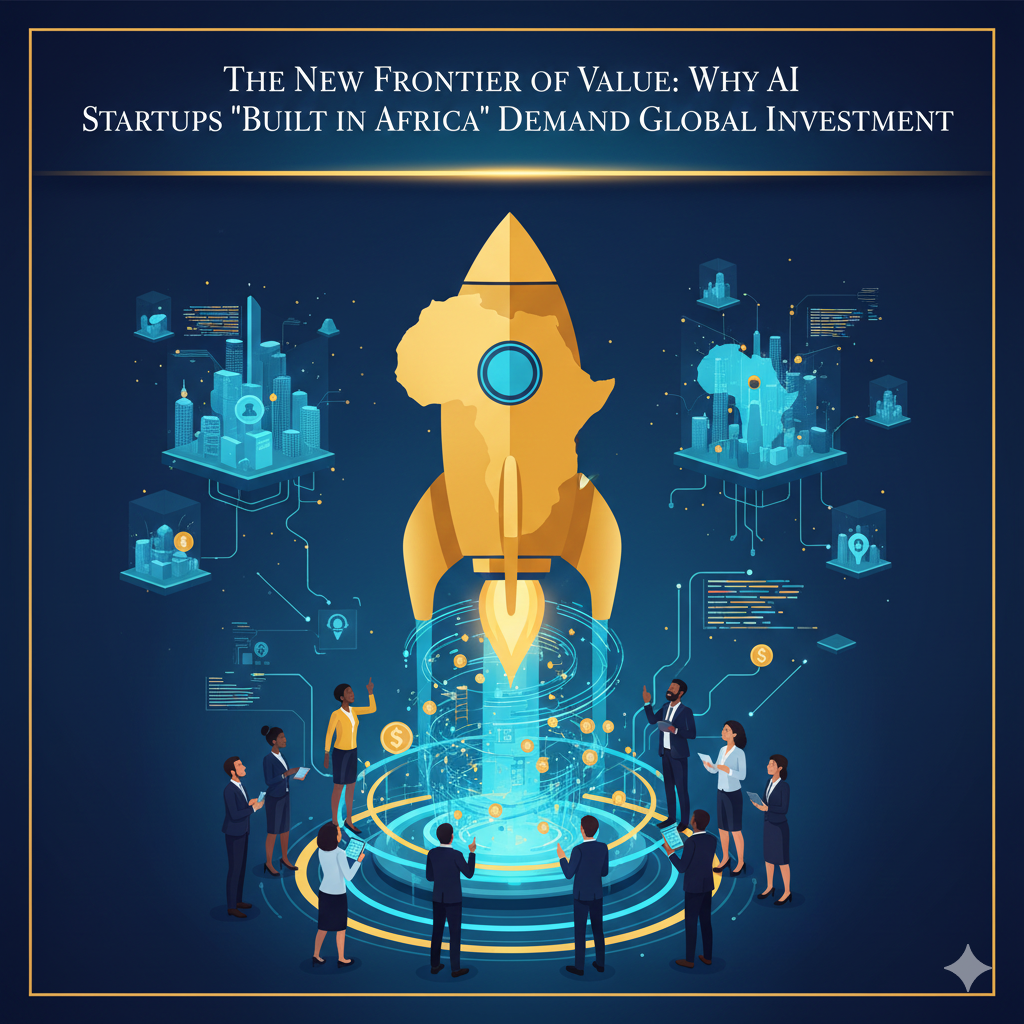
The New Frontier of Value: Why AI Startups “Built in Africa” Demand Global Investment
The African technology landscape is experiencing a fundamental inflection point, moving beyond mere digital adoption toward the creation of proprietary, context-aware artificial intelligence.
This shift constitutes a unique, time-sensitive opportunity for global venture capital and institutional investors.
The thesis for investing in “Built in Africa” AI is underpinned by overwhelming quantitative projections and structural advantages that promise superior risk-adjusted returns compared to saturated global markets.
Africa’s AI market is forecast to transition from an emerging vertical into a hyper-growth engine over the next five years. Current market valuations are estimated between $4.51 billion and $5.17 billion in 2025.1
Robust projections indicate that this market is poised to surge to $16.53 billion by 2030, reflecting an exceptional Compound Annual Growth Rate (CAGR) of 27.42%.2
This growth trajectory is validated by high local institutional confidence: 26% of African chief executives plan to allocate more than 20% of their investment budget to AI in the next 12 months, nearly double the global average of 14%.3
This strong internal market demand signals resilience and validates the B2B opportunity for homegrown solutions.
The strategic investment imperative rests on three converging, globally unique factors. First, the ecosystem benefits from a highly competitive talent pool, offering specialised AI and machine learning expertise at a substantial cost reduction, frequently 40–60% lower than Western counterparts.5
This structural cost efficiency significantly enhances the capital efficiency of African startups. Second, African innovation is driven by necessity, leading to technological “leapfrogging.”
Startups are developing unique, proprietary solutions, not merely optimising global models, that solve systemic, high-value challenges in areas like last-mile logistics, decentralised healthcare, and climate-resilient agriculture.6
Third, the ecosystem’s maturity is validated by high-value strategic acquisitions, such as the $680 million exit of InstaDeep to BioNTech in 2023.7 Such transactions confirm the global quality and return potential of African AI assets, establishing clear exit pathways for early investors.
For global capital, the prudent strategy is to deploy resources immediately and focus deployment within the four established Tier 1 hubs, Nigeria, Kenya, South Africa, and Egypt.
These four nations accounted for an overwhelming 83% of AI startup funding in early 2025 2 and possess the necessary concentration of talent, infrastructure, and policy alignment to guarantee the highest scaling potential and ecosystem maturity.10
Macroeconomic Tailwinds and Market Quantification
Scaling the Market (2025–2030)
The rapid expansion of the African AI market is not isolated but is intricately linked to the continent’s broader digital transformation, which has successfully leveraged mobile technology to skip legacy infrastructure phases.
The existing ecosystem already comprises more than 2,400 AI-focused companies, with significant concentration in South Africa (726), Nigeria (456), and Kenya (204).11 This dense clustering demonstrates a critical mass of entrepreneurial activity capable of sustaining the projected hyper-growth to $16.53 billion by 2030.2
The high projected growth rate of 27.42% is structurally supported by AI’s multiplier effect across sectors that are already dominant in the African economy.
Financial technology (Fintech) remains the most active investment sector, attracting 60% of total equity funding in 2024.12 Fintech revenues across Africa are expected to hit $47 billion by 2030.13
AI is the indispensable layer enabling this exponential growth by improving critical functions such as algorithmic credit scoring for the unbanked, fraud detection, and creating low-cost, mobile-first financial service delivery systems.14
Similarly, the telecommunications sector is projected to unlock an estimated $170 billion in GDP by 2030.16 AI streamlines network management, predictive maintenance, and customer experience necessary to efficiently serve the next 500 million users coming online.
The deployment of AI is therefore not reliant on building new industrial infrastructure but rather on integrating intelligence into massive, existing mobile-first platforms, which provides startups with an immediate, vast distribution network and enormous dataset access, thus fueling the impressive CAGR.
Mapping the Investment Landscape
Capital deployment efficiency across Africa is optimised by targeting the proven, high-density ecosystems. Data confirms that investment activity is highly concentrated: Nigeria, Kenya, South Africa, and Egypt collectively captured 83% of AI startup investment in the first quarter of 2025.2
Furthermore, these “Tier 1” nations account for approximately 87% of the continent’s total AI funding.10 This clustering of capital mirrors infrastructure density, which is a key de-risking factor for AI ventures that rely heavily on low-latency computation.
South Africa leads with 49 data centers, followed by Kenya (18), Nigeria (16), and Egypt (14).10
The presence of this core data infrastructure, coupled with the direct presence of global hyperscalers, Amazon AWS, Microsoft Azure, and Google Cloud—in these Tier 1 nations, fundamentally reduces the friction and cost associated with scaling complex AI models.10
The current high concentration of funding and infrastructure in these four markets provides a structured, high-efficiency entry strategy for global investors.
By focusing capital deployment here, investors mitigate the general risk associated with geographic dispersion and resource instability often attributed to continent-wide strategies, ensuring that capital supports ecosystems with a critical mass of infrastructure, talent, and existing regulatory frameworks.
Table 1: African AI Market Size and Investment Concentration (2025-2030)
Metric | 2025 Estimate (USD) | 2030 Projection (USD) | CAGR (2025-2030) | Investment Hub Concentration |
|---|---|---|---|---|
AI Market Value | $4.51B – $5.17B 1 | $16.53B 2 | ~27.42% 2 | 83% of funding in SA, NG, KE, EG 2 |
Total AI Companies (Approx.) | >2,400 11 | N/A | N/A | SA (726), NG (456), KE (204) 11 |
CEO AI Budget Allocation (>20%) | 26% (vs. 14% Global Avg) 3 | N/A | N/A | Internal validation of growth 3 |
The African Advantage: Leapfrogging to Leadership
Innovation Born of Necessity
The prevailing narrative in African technology is one of technological leapfrogging, famously exemplified by M-Pesa, which bypassed traditional landline and banking infrastructure to connect millions to the digital economy.6
Artificial intelligence represents the next, more profound, iteration of this phenomenon. African AI is not merely optimising existing Western models; it is fundamentally redesigning solutions to circumvent pervasive systemic barriers, such as limited classroom access, vast distances in healthcare delivery, or fragmented road infrastructure.18
This focus on fundamental problem-solving, born from necessity, yields solutions that are inherently more robust and innovative than those developed for resource-abundant environments.
This proactive stance is formalied at the continental level. The African Union (AU) has adopted an ambitious, future-oriented AI policy architecture, articulating a vision for sovereign AI ethics and climate adaptation.19
The AU uses these policy frameworks to assert an African direction for AI and mobilise institutional support, often before the material capacity to sustain it fully exists.19
This policy-driven approach creates a favourable, forward-looking environment for AI developers, setting out a clear agenda that aligns innovation with developmental goals.
Deep Dive: High-Impact, Scalable Solutions
African AI startups are targeting massive, underserved markets where inefficiency is costly, and technological intervention yields immediate, scalable results.
Logistics Efficiency and Last-Mile Delivery
Logistics costs across Africa are exceptionally high, often representing up to 75% of a product’s final price.20
AI is proving essential for streamlining operations and competing in this complex landscape. A prime example is Leta.ai (Kenya), a firm that successfully scaled its AI-driven predictive analytics platform across several African nations.
By leveraging machine learning for smarter route planning and automated dispatching, Leta achieved a 30% reduction in delivery times and cut operational costs by 15%, maintaining a 95% on-time delivery rate.20
The firm’s rapid growth is evident in the five-fold increase in revenues and the expansion of its delivery volume from 500,000 to 4.5 million, securing $5 million in seed funding and attracting major corporate clients like KFC and Diageo across five countries.20
Leta’s success proves the immense regional market demand for deep-tech logistics solutions that can navigate infrastructural challenges.
Healthcare Diagnostics and Access
Artificial intelligence is a crucial tool for addressing the severe human resource gaps and persistent diagnostic delays in African healthcare.22
The continent often lacks the ratio of diagnostic professionals to patients seen globally. AI-enabled diagnostic tools, particularly those built into mobile platforms and point-of-care devices, extend specialised care to resource-limited and rural areas.
These tools can analyse lab results, interpret pathology slides, and flag abnormalities rapidly, reducing diagnostic turnaround times from days to minutes.22
Healthtech company Healthtracka (Nigeria) demonstrates this impact, having delivered 40,000 at-home tests using its AI-powered application to improve access to healthcare, successfully decentralising care in a massive market.23
Climate-Resilient Agriculture
Addressing food security and enhancing agricultural productivity are existential challenges in climate-vulnerable regions of Sub-Saharan Africa.24
Home-grown AI innovations are specifically tailored to tackle these unique production challenges.25 The Artificial Intelligence for Agriculture and Food Systems Innovation Research Network (AI4AFS), for example, aims to deliver AI-based solutions that demonstrate a minimum 20% improvement in crop yield or disease detection outcomes. This would directly enhance the resilience and livelihoods of small-scale farmers.25
The profound significance of these localised solutions is the creation of proprietary data advantage. Startups that successfully develop models for predicting traffic congestion in Lagos, managing supply chains through inconsistent connectivity, or diagnosing specific regional diseases are generating context-aware datasets that are globally unique and cannot be easily replicated by foreign competitors relying on Western or Asian data.26
This inherent requirement to solve complex, local problems means African AI models possess a decisive, durable, and defensible competitive moat, guaranteeing higher future strategic valuation.
This focus on localised relevance also extends to digital infrastructure. Governments recognise that for mass adoption and digital inclusion, AI must speak local languages.
The Nigerian government is actively collaborating with the private sector to build multilingual Large Language Models (LLMs) in five local languages.27
Similarly, Intella (Egypt) raised $12.5 million in a Series A round to scale Arabic-language AI models.28 Investments that support the development of these sovereign AI assets, models trained on specific local languages and contexts, are inherently aligned with national strategic priorities, often leading to government partnerships, favorable regulation, and unlocking vast, currently unserved user bases.
Human Capital: The Cost-Effective Engine of Growth
Talent Supply and Geographic Density
Africa possesses a rapidly expanding pool of digital talent, concentrated in established tech hubs that have become incubators of innovation.
Cities like Nairobi (“Silicon Savannah”), Lagos (the continent’s Fintech powerhouse), Cape Town, and Cairo have nurtured ecosystems capable of producing a steady flow of high-quality professionals.5
While the continent is proactively addressing the reported shortage of AI expertise, with two-thirds of businesses having implemented professional development initiatives to upskill or reskill personnel 11, the quality and growth of the talent pool are undeniable.
Governments are actively reinforcing this growth through policies such as Kenya’s Ajira Digital Program and Nigeria’s Startup Act, which incentivise tech-driven enterprises and enhance digital readiness.5
Quantifying the Global Competitive Advantage
The primary financial attraction of African human capital is its sheer cost-effectiveness, which fundamentally improves the capital efficiency of startups.
African professionals including software developers, data analysts, and ML engineers, offer high-quality services at competitive rates, often charging 40–60% less than their Western counterparts.5
This competitive rate structure allows venture-backed companies to extend their runway and achieve critical milestones with significantly less deployed capital.
The most potent factor in this equation is the structural operational cost arbitrage achieved by combining affordable, specialised human capital with AI automation.
Modern AI startups are inherently leaner than traditional tech companies, automating core functions like customer support and operations, allowing small teams to manage massive scale.26
When these automated, lean operating models are combined with a 40–60% reduction in talent costs, African AI startups achieve a vastly superior annual revenue per employee (ARPE) potential and a faster trajectory to profitability than models constrained by high global salaries.
Building the Future Workforce
African business leaders exhibit a unique and pragmatic approach to talent management that de-risks the brain drain often associated with rapidly developing tech ecosystems.
Executives surveyed demonstrate a marked preference for developing talent internally: 81% believe training their staff in AI will have a direct impact on success, compared to 77% globally.3
Correspondingly, African CEOs express less anxiety about competition for AI talent (64%) compared to their global counterparts (70%).3
This cultural prioritisation of in-house skills development over rapid, high-cost external recruitment creates long-term stability for portfolio companies, reducing talent volatility and sustaining the competitive cost advantage.3
Furthermore, African professionals are often motivated by the opportunity to work on high-impact, context-relevant challenges that directly affect their communities, fostering loyalty that acts as a valuable counter-measure to purely salary-driven recruitment from international firms.26
De-Risking the Portfolio: Addressing Investor Concerns
Liquidity and the Maturing Exit Pipeline
Concerns regarding exit liquidity, once a significant barrier for African VC, are being systematically addressed by a maturing ecosystem demonstrating clear, high-value acquisition pathways.
Data shows a significant maturation since 2020, with over 100 startup exits recorded between 2023 and 2025, including more than 50 mergers and acquisitions in 2025 alone, the highest annual figure in the last five years.7
Two landmark acquisitions have fundamentally validated the potential for high returns:
- InstaDeep (Tunisia): Acquired by German multinational BioNTech in 2023 for $680 million.7 This acquisition signals a crucial shift in global buyer motivation. InstaDeep was purchased not primarily for its African customer base, but for its specialised deep AI research and world-class engineering capability. This demonstrates that African AI companies are increasingly valued for their technology, intellectual property (IP), and talent (inputs) rather than solely for market penetration (outputs).
- Paystack (Nigeria): The $200 million acquisition by Stripe in 2020 set an early benchmark for successful strategic M&A in the region.29
These transactions confirm that African AI assets attract high global valuations based on proprietary IP and the demonstrated ability of their engineering teams.
This maturing exit landscape allows investors to shift away from purely hunting “unicorns” and instead rely on consistent smaller exits that compound into strong portfolio performance.30
Navigating Infrastructure Gaps and Building Resilience
While Africa possesses less than 1% of global data center capacity 1 and a reported 95% deficit in the computational power needed by its AI talent 32, entrepreneurs view these constraints as design challenges rather than insurmountable barriers.
The foundational compute deficit is being proactively addressed by major infrastructure players. Initiatives like the Cassava Technologies and Rockefeller Foundation partnership, which involves building Africa’s first AI factory powered by NVIDIA AI infrastructure, are vital.1
This effort provides locally accessible compute capacity, enabling developers to train complex models using local datasets and languages, a necessary step for achieving technological self-sufficiency.1
At the startup level, founders build resilience into their architectural design from inception. Operational instability, particularly power and internet outages, is managed through the use of localised power solutions and AI tools designed to function offline or with minimal connectivity.33
Furthermore, startups proactively partner with local telecom providers for dedicated bandwidth or investigate satellite internet options to ensure continuous operations.33
The necessity of engineering AI systems that function reliably despite intermittent infrastructure means African startups are building products that are inherently more robust and globally transferable.
For instance, a logistics solution that maintains high reliability metrics in a highly fragmented environment, such as Leta.ai’s 95% on-time delivery rate 20, possesses operational IP that is highly valuable and exportable to other challenging emerging markets worldwide.
Regulatory Stability and Governance
The regulatory environment is rapidly stabilising and becoming increasingly conducive to AI investment, largely due to proactive government engagement. At least 23 African countries have established national AI strategies, drafts, or readiness assessments.34
This action signals clear governmental commitment and provides essential certainty for investors, outlining priorities for resource allocation toward infrastructure and talent development.35
Furthermore, regional integration efforts, supported by blocs like the East African Community (EAC) and the African Continental Free Trade Area (AfCFTA), are striving to harmonise policies and establish cross-border data transfer frameworks, facilitating frictionless scaling across large regional markets.27
The African Union’s Continental AI Strategy acts as an overarching vision, leveraging policy to assert continental priorities like climate adaptation and sovereign ethics.19
Investors should recognise that this regulatory framework functions as a strategic lever. Investments that align with stated national developmental priorities such as AgriTech for food security 25 or localised LLMs for inclusion 27 are intrinsically de-risked and are more likely to secure favorable regulatory treatment, public contract opportunities, and catalytic financial support.
Public financial vehicles, such as South Africa’s R 2.7 billion Innovation Fund, actively mobilise private capital at a high multiplier, reducing early-stage risk.37
While regulatory uncertainty, such as taxation volatility, remains a threat in some countries (e.g., Kenya’s digital-services tax led to a significant funding drop 37), this risk is best mitigated by partnering with local investors who possess deep expertise in navigating regional policy changes.30
Table 2: Investor Risk Mitigation Strategies in African AI Ecosystem
Investor Concern/Risk | Underlying Driver | Mitigation Strategy & African Innovation | Impact on Portfolio Value |
|---|---|---|---|
Infrastructure Instability | Low data center capacity, unreliable power 10 | Resilient architecture (offline functionality); localized compute factories (Cassava/NVIDIA) 1 | Ensures business continuity and scalability; creates globally robust IP. |
Exit Liquidity & Valuation | Perceived lack of M&A pathways | Proven strategic acquisitions by global giants (InstaDeep, Paystack) 7 | Validates global valuation and ensures clear exit optionality based on specialized IP. |
Regulatory Vacuum/Uncertainty | Emerging governance frameworks | Proactive national strategies (23+ countries); AU Continental Policy 34 | Provides legal certainty; aligns startups with governmental priorities (sovereign AI). |
Talent Cost/Retention | Global talent poaching; local skills gap 11 | Cost-effectiveness (40-60% savings); CEO focus on long-term internal training 3 | Reduces long-term operational costs; ensures team stability and IP protection. |
Conclusion
The “Build in Africa” narrative for AI startups is not an appeal for developmental capital but a data-backed case for generational investment returns.
The confluence of hyper-growth market projections, structural cost advantages inherent in the human capital pool, and the strategic edge provided by context-driven, proprietary data moats confirms that African AI represents the most compelling new frontier of value creation in the global technology landscape.
The need for these technologies is immense, and the capacity to solve these problems with capital efficiency is unparalleled.
The Cost of Waiting: Missing the Inflection Point
The window for low-cost, foundational equity investment is rapidly closing. The strong concentration of 87% of AI funding in the four Tier 1 hubs indicates that these ecosystems are quickly maturing.
Investors who defer capital deployment risk missing the current valuation sweet spot, potentially entering the market later at significantly higher multiples.
The opportunity today is to secure foundational equity in the companies poised to dominate essential regional value chains nemely, logistics, finance, and health, through AI solutions built for resilience and scalability.
Recommended Investment Strategy for Global Capital
- Geographic Concentration and De-risking: Capital should be primarily focused on the Tier 1 hubs, South Africa, Nigeria, Kenya, and Egypt, to leverage established digital readiness, infrastructure density, and the presence of global hyperscalers.10 This approach optimises scaling potential and minimizes capital deployment risk.
- Sectoral Focus on Systemic Value: Prioritise AI applications that provide systemic solutions to high-cost African problems, such as logistics optimization, decentralised healthcare diagnostics, and climate AgTech, where proprietary data moats are strongest and impact is immediate.20
- Mandatory Local Partnership and Policy Alignment: Utilise local VC partners to mitigate regulatory risk and navigate information asymmetry.30 Ensure portfolio companies actively align their offerings with continental and national AI strategies to secure policy support and potential public procurement contracts, leveraging the strategic alignment demonstrated by the AU.19
- Strategic Resource Provision: Investors should commit to providing portfolio companies with crucial non-capital resources, specifically compute access (leveraging partnerships like the Cassava AI factory 1) and technical mentorship to transform infrastructure constraints into globally exportable competitive features.
References
- Cassava Technologies and Rockefeller Foundation Expand Access to Artificial Intelligence Computing to African NGOs, https://www.rockefellerfoundation.org/news/cassava-technologies-and-rockefeller-foundation-expand-access-to-artificial-intelligence-computing-to-african-ngos/
- North vs. Sub-Saharan Africa: AI Investment Trends, https://www.techinafrica.com/north-vs-sub-saharan-africa-ai-investment-trends/
- AI: 26% of African companies plan to invest more than 20% of their budget within 12 months (KPMG), https://extensia.tech/ai-26-of-african-companies-plan-to-invest-more-than-20-of-their-budget-within-12-months-kpmg/
- African CEOs Plan Higher AI Spending, With 26 % Allocating Over 20 % (KPMG), https://www.ecofinagency.com/ecofin-pro/1911-50597-african-ceos-plan-higher-ai-spending-with-26-allocating-over-20-kpmg
- Africa’s Remote Workforce Growth: Talent, Tech, Jobs, Skills, Digital Economy, https://www.africanleadershipmagazine.co.uk/africas-remote-workforce-growth-talent-tech-jobs-skills-digital-economy/
- Can Africa leapfrog again? Prompt literacy as the next economic frontier, https://africa.businessinsider.com/local/markets/can-africa-leapfrog-again-prompt-literacy-as-the-next-economic-frontier/cg5y6vp
- The State of Startup Exits in Africa in 5 Charts – TechCabal Insights, https://insights.techcabal.com/the-state-of-startup-exits-in-africa-in-5-charts/
- Top 10 AI Startups in Africa in 2025 – The African Exponent, https://www.africanexponent.com/top-10-ai-startups-in-africa-in-2025/
- 30 Interesting Artificial Intelligence Statistics About Africa [2025] – DigitalDefynd, https://digitaldefynd.com/IQ/artificial-intelligence-statistics-about-africa/
- Africa’s AI divide: The three tiers of digital readiness – TechCabal Insights, https://insights.techcabal.com/africas-ai-divide-the-three-tiers-of-digital-readiness/
- AI Projected to Add $1,5 Trillion in Africa by 2030 – SAP News, https://news.sap.com/africa/2025/06/ai-projected-to-add-15-trillion-in-africa-by-2030/
- 2024 Partech Africa Tech VC Report: With US$3.2B Raised, African Startups Show Resilience Despite 7% Drop in Funding, https://partechpartners.com/news/2024-partech-africa-tech-vc-report-with-us32b-raised-african-startups-show-resilience-despite-7-drop-in-funding
- Fintech in Africa: McKinsey Forecasts $47 Billion Boom by 2028 – Bein crypto, https://fr.beincrypto.com/fintech-africa-market-47-billion-2030/
- East Africa advances mobile-first messaging to accelerate financial inclusion – Ai Impact, https://ai-impact.co.za/east-africa-advances-mobile-first-messaging-to-accelerate-financial-inclusion/
- Intelligent Finance Solution – Huawei Enterprise, https://e.huawei.com/en/industries/finance
- Remember the future: The next frontier for African telcos – McKinsey, https://www.mckinsey.com/industries/technology-media-and-telecommunications/our-insights/remember-the-future-the-next-frontier-for-african-telcos
- Connecting Africa to opportunities by closing the digital divide – Source EMEA, https://news.microsoft.com/source/emea/features/connecting-africa-to-opportunities-by-closing-the-digital-divide/
- Artificial Intelligence: Africa’s Opportunity to Leapfrog Development – Malawiace.com, https://malawiace.com/2025/02/11/artificial-intelligence-africas-opportunity-to-leapfrog-development/
- Strategic paradox: how the African Union performs the future through AI policy, https://www.bennettschool.cam.ac.uk/blog/strategic-paradox-how-the-african-union-performs-the-future-through-ai-policy/
- How AI Improves Logistics for African Startups – Tech In Africa, https://www.techinafrica.com/how-ai-improves-logistics-for-african-startups/
- Kenyan Startup Leta Raises $5 Million to Boost AI-Powered Logistics Platform in Africa, https://empowerafrica.com/kenyan-startup-leta-raises-5-million-to-boost-ai-powered-logistics-platform-in-africa/
- The role of artificial intelligence in diagnostics: A new frontier for laboratory medicine in Africa – PMC – PubMed Central, https://pmc.ncbi.nlm.nih.gov/articles/PMC12505451/
- Bridging the diagnostics gap in Africa with AI-powered solutions | Devex, https://www.devex.com/news/bridging-the-diagnostics-gap-in-africa-with-ai-powered-solutions-109855
- Is Artificial Intelligence the future of farming? Exploring opportunities and challenges in Sub-Saharan Africa – World Bank Blogs, https://blogs.worldbank.org/en/agfood/artificial-interlligence-in-the-future-of-sub-saharan-africa-far
- Enhancing Africa’s agriculture and food systems through responsible and gender inclusive AI innovation: insights from AI4AFS network – PubMed Central, https://pmc.ncbi.nlm.nih.gov/articles/PMC11798938/
- How AI Startups are Using Technology to Grow & Scale – Registry Africa, https://registry.africa/how-ai-startups-are-using-technology-to-grow-and-scale/
- Understanding Africa’s AI Governance Landscape: Insights From Policy Practice and Dialogue | Carnegie Endowment for International Peace, https://carnegieendowment.org/posts/2025/09/understanding-africas-ai-governance-landscape-insights-from-policy-practice-and-dialogue?lang=en
- African Startups Raise $140 Million in September, Bringing 2025 Total Funding to $2.2 Billion – Empower Africa, https://empowerafrica.com/african-startups-raise-140-million-in-september-bringing-2025-total-funding-to-2-2-billion/
- From Idea to Exit: African Founders Who Sold Their Startups (And How They Did It), https://www.techinafrica.com/from-idea-to-exit-african-founders-who-sold-their-startups-and-how-they-did-it/
- Risk and Reward: Understanding the Unique Dynamics of African VC – Ingressive Capital, https://ingressivecapital.com/african-vc-risk-and-reward/
- Top 10 African countries with the most data centers in 2025, https://africa.businessinsider.com/local/lifestyle/top-10-african-countries-with-the-most-data-centers-in-2025/25sh9hp
- Redefining innovation: How entrepreneurs in Africa are shaping the future with AI – Acumen, https://acumen.org/blog/africa-entrepreneurs-ai-innovation/
- How AI Improves Risk Management for African Startups – Tech In Africa, https://www.techinafrica.com/how-ai-improves-risk-management-for-african-startups/
- Africa’s AI Future Depends On Talent, Not Just Technology – Column, https://columncontent.com/africa-ai-talent/
- African Countries Are Racing to Create AI Strategies – But Are They Putting the Cart Before the Horse?, https://www.globalcenter.ai/research/african-countries-are-racing-to-create-ai-strategies-but-are-they-putting-the-cart-before-the-horse
- High-Level Side Event Thematic Areas – East African Community, https://www.eac.int/upcomingeventsat25/side-event/thematic-areas
- Shaping the future of an African VC landscape | ITU, https://www.itu.int/itu-d/sites/innovation-alliance/wp-content/uploads/sites/35/2025/10/FBS_-Shaping-the-future-of-an-African-VC-landscape_Signed-BDTDirector.pdf