

How to Handle Investor Questions
For many founders, the most intimidating part of pitching investors is not the presentation.
It is the questions that come afterward.
You might deliver a great pitch, feel confident about your slides, and then an investor asks something unexpected:
- “Why hasn’t a bigger company built this already?”
- “What happens if a competitor raises $50 million?”
- “How do you know customers will actually pay for this?”
Suddenly the conversation feels like an interrogation.
But here’s an important shift in perspective:
Investor questions are not attacks — they are signals of interest.
If investors are asking questions, it usually means they’re thinking seriously about the opportunity.
The founders who raise funding successfully are not the ones who avoid tough questions. They’re the ones who handle them calmly, clearly, and confidently.
This article will show you how to approach investor questions strategically, prepare effectively, and respond in ways that build trust.
Why Investors Ask Questions
Investors ask questions for several reasons, and understanding their motivation helps you respond more effectively.
1. To Evaluate Your Thinking
Investors want to see how you think under pressure.
Do you respond logically?
Do you stay calm?
Do you show insight into the problem?
Your answers reveal your decision-making ability.
2. To Test Your Assumptions
Every startup relies on assumptions:
- customers will adopt the product
- the market will grow
- competitors won’t dominate
- the team can execute
Investors ask questions to stress-test those assumptions.
A helpful resource explaining this process is the Y Combinator startup library.
3. To Understand Risk
Investing in startups is inherently risky.
Questions help investors identify the biggest potential risks, such as:
- market uncertainty
- technical feasibility
- customer adoption
- competitive threats
Your ability to address these risks thoughtfully increases investor confidence.
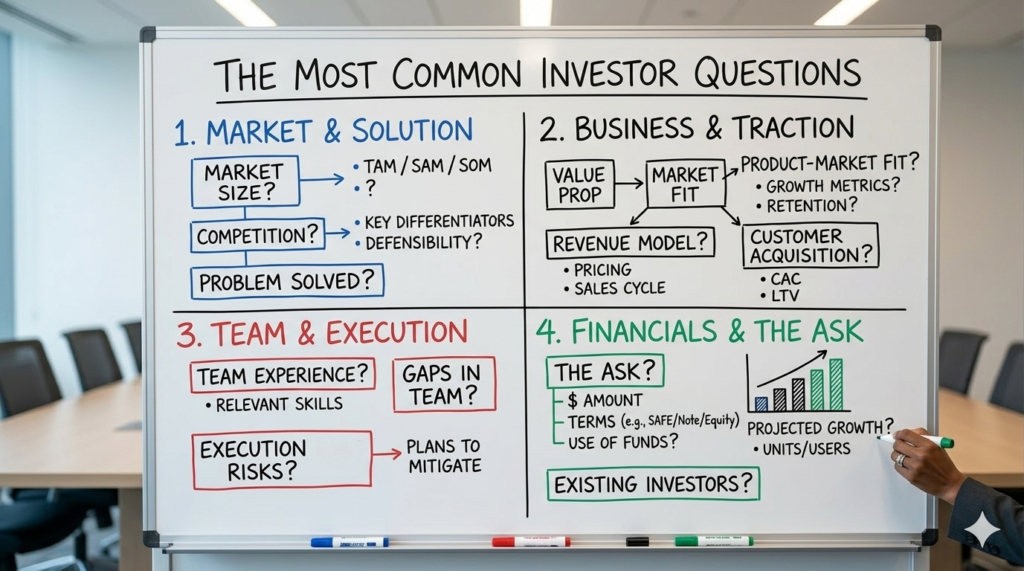
The Most Common Investor Questions
While every conversation is different, many investor questions fall into a few predictable categories.
Understanding these categories helps you prepare.
Market Questions
Investors often ask:
- How big is the market?
- Who are your customers?
- Why is this problem important now?
These questions help investors evaluate the size and urgency of the opportunity.
For guidance on explaining market size clearly, Antler provides a useful overview.
Product Questions
Investors may ask:
- How does your product work?
- What makes it different from competitors?
- Why is your solution better?
The goal here is to understand your product’s value and differentiation.
Traction Questions
Investors often focus heavily on traction:
- How many customers do you have?
- What are your growth metrics?
- What feedback have users given?
These questions provide evidence that the idea is gaining real-world momentum.
A helpful resource discussing traction and early-stage validation is here.
Team Questions
Investors also evaluate the founding team.
Questions might include:
- Why are you the right team for this problem?
- What experience do you bring?
- How will you recruit talent?
Investors often believe that strong teams can pivot and adapt, even if the original idea changes.
Competition Questions
Nearly every pitch leads to competition-related questions.
Examples include:
- Who are your competitors?
- Why haven’t they solved this problem?
- What prevents new entrants from copying you?
A helpful discussion on competitive positioning can be found here.
How to Answer Investor Questions Effectively
Handling investor questions well is less about having perfect answers and more about communicating clearly and thoughtfully.
Here are key strategies that experienced founders use.
1. Listen Carefully Before Responding
When a question is asked, resist the urge to respond immediately.
Instead:
- listen fully
- make sure you understand the question
- pause briefly before answering
This prevents misunderstandings and helps you provide a more precise response.
If the question is unclear, it’s perfectly acceptable to ask:
“Could you clarify what you mean?”
This shows professionalism rather than weakness.
2. Answer Directly
Some founders try to avoid difficult questions by giving vague or unrelated answers.
Investors notice this quickly.
Instead, answer the core question directly, then add supporting context.
Example:
Investor question:
“What stops competitors from copying your product?”
Weak response:
“We believe our technology is very advanced and our team is highly capable.”
Stronger response:
“Our main advantage comes from the proprietary data we’re collecting. As more customers use our platform, the data improves our algorithms, which creates a compounding advantage.”
The second answer addresses the concern more directly.
3. Use Evidence When Possible
Strong answers often include evidence or examples.
Evidence can include:
- user feedback
- pilot results
- early revenue
- market research
- comparable companies
For example:
“We tested the product with 50 businesses during our pilot program. Forty-three of them continued using the product after the trial.”
Evidence turns speculation into credibility.
4. Be Honest When You Don’t Know
No founder has every answer.
Trying to fake knowledge can damage credibility.
If you genuinely don’t know something, you can say:
“That’s a great question. We’re still gathering data in that area, but our current assumption is…”
or
“We don’t have a definitive answer yet, but it’s something we’re actively testing.”
Investors generally respect honest, thoughtful responses.
5. Stay Calm Under Pressure
Some investors deliberately ask challenging questions to see how founders react.
If a question feels critical or skeptical, avoid becoming defensive.
Instead:
- acknowledge the concern
- explain your reasoning
- keep your tone calm
For example:
“That’s a fair concern. Here’s how we’ve been thinking about it…”
Remaining composed signals leadership and maturity.
Turning Questions Into Opportunities
Investor questions can also be used strategically.
When answered well, they can reinforce the strengths of your startup.
For example:
Investor question:
“Isn’t this market already crowded?”
Opportunity response:
“Yes, the market is active, which actually validates the demand. What we’re seeing is that existing solutions focus on large enterprises, while smaller companies remain underserved. That’s where we’re focusing.”
Instead of defending yourself, you reframe the conversation.

Preparing for Investor Q&A
Preparation dramatically improves how founders handle questions.
Here are a few practical preparation techniques.
Create a Question List
Write down the most likely investor questions across these areas:
- market
- product
- traction
- competition
- team
- financials
Then draft concise answers for each.
Practice With Mock Investors
Ask mentors, advisors, or fellow founders to simulate an investor Q&A session.
Encourage them to ask difficult questions.
This helps you:
- refine your answers
- improve clarity
- build confidence
Study Investor Perspectives
Understanding how investors think helps you anticipate their questions.
Useful insights from venture investors can be found here.
Learning what investors look for makes their questions easier to interpret.
Common Mistakes Founders Make During Q&A
Even experienced founders sometimes make mistakes when answering investor questions.
Here are some common pitfalls to avoid.
Talking Too Long
Overly long answers can lose the listener’s attention.
Aim for clear and concise responses.
Becoming Defensive
Investor skepticism is normal.
Treat it as part of the evaluation process, not personal criticism.
Guessing Without Evidence
Speculative answers without data can weaken credibility.
Whenever possible, support your response with data or reasoning.
Interrupting the Question
Let the investor finish speaking before responding.
Interruptions can come across as nervous or impatient.
A Simple Framework for Strong Answers
A useful structure for answering investor questions is the CLEAR framework:
C — Clarify the question
Ensure you understand what is being asked.
L — Lead with the direct answer
Address the core question immediately.
E — Explain your reasoning
Provide logic or context.
A — Add evidence if available
Support your answer with examples or data.
R — Reinforce your strategy
Show how your approach addresses the issue.
This structure keeps answers organized and persuasive.
Final Thoughts
Investor questions are not obstacles — they are part of a meaningful conversation about your startup’s potential.
The best founders approach these conversations with curiosity and confidence, not fear.
Remember these key principles:
- listen carefully before answering
- respond clearly and directly
- support answers with evidence
- stay calm under pressure
- be honest when uncertain
When handled well, investor questions become opportunities to demonstrate something investors care deeply about:
your ability to think clearly and lead through uncertainty.
And that ability often matters just as much as the idea itself.
Ready to Ace Your Next Funding Pitch?
Join thousands of founders who have improved their pitch skills and secured funding with our automated interview simulator.