
From Disaster Mitigation to Asset Protection: The Institutional Pivot Behind ClimatrixAI Thesis
FOUNDER SNAPSHOT
Umar Fahm
STARTUP
ClimatrixAI
STAGE
Pilot Stage
GEOGRAPHY
Middle East and Africa (MEA)
SECTOR
Climate Technology
The Core Problem
The fundamental friction in climate risk mitigation within the Global South is the structural gap between global meteorological models and street-level reality.
Existing global satellite data and agencies like the Nigeria Meteorological Agency (NIMET) provide macro-level forecasts that lack the granularity required for actionable decision-making.
For instance, a forecast may predict increased rainfall across a state but fails to identify specific neighbourhoods or timeframes likely to experience flash flooding.
This absence of specificity renders the data useless for infrastructure operators and sensitive industries.
The problem is compounded by a lack of clean, accurate local data, creating a high-stakes information vacuum during environmental crises.
ClimatrixAI has been conceptualised and optimised to bridge these gaps

The Strategic Decision Layer
The founder’s decision to pivot from a pure flood early-warning system to a broader climate intelligence and asset-level risk scoring solution is a significant signal of strategic maturity.
This shift reflects an understanding that the market is not seeking simple alerts, but rather the analytical layer that allows stakeholders to integrate environmental risk into their existing operational workflows.
More interesting than the technology itself was the decision to prioritise downscaling.
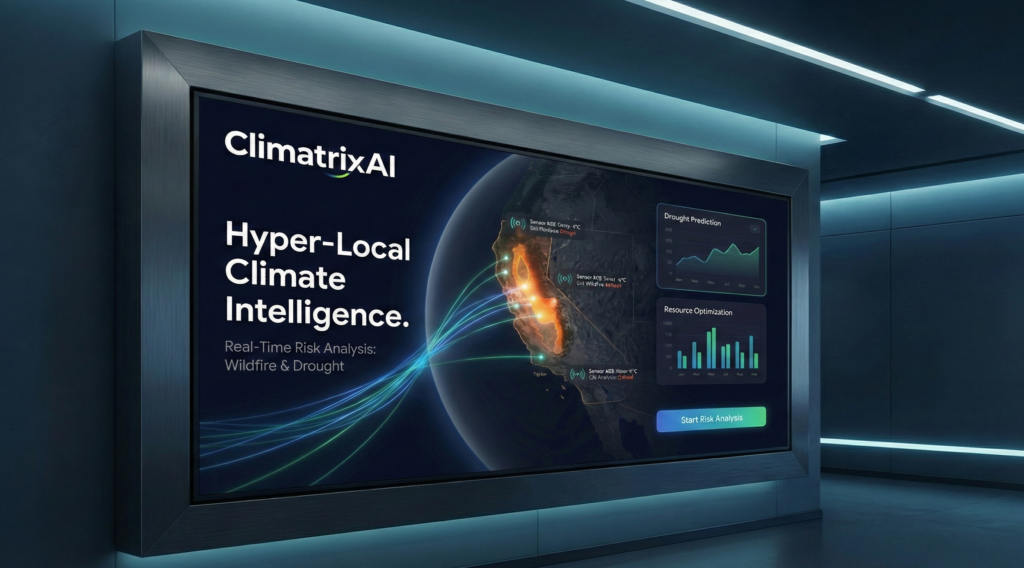
By choosing to downscale large data models into hyper-local, street-level predictions, the startup is bridging the gap between synoptic-scale meteorology and micro-scale urban topography, betting on accuracy as its primary moat rather than just speed to market.
This approach requires more rigorous engineering but addresses the core failure of substitute global models.
The sequencing here is worth examining because the founder reports a focus on software and the ClimatrixAI API that leverages existing data sources before deploying a hardware-heavy network of Edge-AI IoT weather stations, such as DrainSentinel and HydroSentinel.
This reveals a disciplined approach to resource allocation by accepting the trade-off of temporary data limitations in exchange for lower burn and faster iteration, while providing the core analytical logic for where the physical hardware layer will eventually be optimised.
Furthermore, the decision to target high-sensitivity sectors like real estate, agriculture, and health via APIs indicates a sophisticated market thesis.
It moves the product from a niche disaster-management tool to a core component of the B2B tech stack in emerging markets.
Ecosystem Context
What this experience reveals about the regulatory environment in the MEA region is a looming shift toward mandatory ESG (Environmental, Social, and Governance) compliance.
In Egypt, non-financial institutions are already being mandated to file environmental reports, and a similar trajectory is expected in Nigeria by 2028 under emerging National Council on Climate Change (NCCC) frameworks.
The friction described regarding data collection reflects a structural condition common to the Global South with its resource-weak infrastructure.
For investors, this case surfaces an important consideration that the most resilient climate tech in these geographies will be those that build workarounds for data scarcity rather than those that depend on government-provided infrastructure.
The workaround adopted here which is, a planned crowdsourcing model for geostamped visual data, is a recurring pattern among founders operating in environments with significant physical infrastructure gaps.
It suggests that social coordination may be a necessary prerequisite for technical accuracy in these markets.
Observable Signals
There is strong evidence of high-signal technical clarity regarding the limitations of current global weather models.
The founder demonstrates unusual discipline in technical risk mitigation, opting to leverage AWS and NVIDIA credits to maintain a lean operation while iterating on the core predictive predictive engine.
What is visible here indicates a pattern of execution quality prioritised over hype.
The founder reports five failed models before achieving a functional MVP during the iterative development of the FloodSentinel engine, which suggests a high degree of founder self-awareness and persistence in the face of technical complexity.
A highly credible early signal of market validation is seen in the reported interest from real estate firms looking to integrate environmental risk APIs into their platforms, further reinforced by institutional validation such as winning the UNICEF Global Climate Innovation Challenge Award.
This suggests that the category problem being solved is recognised by institutional actors, even if the broader climate tech landscape in the region remains nascent.
Open Variables
The competitive framing visible in the public narrative focuses on local specificity as a differentiator.
Whether the planned data crowdsourcing model can achieve the volume and quality of input required to meaningfully improve prediction accuracy is an open variable.
The scalability of the subscription-based dashboard model versus the custom pilot contract model is not yet apparent at this stage.
These structural ambiguities are common at the early commercialisation stage, where the balance between standardised SaaS and bespoke institutional consulting is often resolved through sustained market contact.
Why This Matters
For investors evaluating the Global South, this case demonstrates how data scarcity can be transformed from a barrier into a barrier to entry.
Founders who can successfully downscale macro-data to solve micro-level logistical problems are creating a proprietary intelligence layer that is difficult for global players to replicate.
This matters to DFIs and ecosystem operators because it signals the emergence of a domestic, sovereign climate intelligence infrastructure that does not rely on Western-centric models.
It represents a shift from being a consumer of global data to being a producer of localized intelligence.
Final Strategic Takeway
In markets defined by resource weakness, the most successful founders are rarely those with the most hardware, but those who can build the most accurate analytical layer over the least amount of reliable data.
This article is drawn from an in-depth founder interview conducted by Afriq IQ with Umar Fahm, CEO of Climatrix AI. Selected insights and observations are published here.
Ready to Ace Your Next Funding Pitch?
Join thousands of founders who have improved their pitch skills and secured funding with our automated interview simulator.