

Africa’s GPU Gap: What Udu Technologies Is Doing That Nobody Else Would
FOUNDER SNAPSHOT

Alexander Tsado
STARTUP
STAGE
Early traction, GPUs deployed
GEOGRAPHY
United States • Pan African
SECTOR
AI infrastructure
The Man Before the Company
Alexander Tsado grew up in Benin City, Nigeria and also went to a public school there.
He then went on to attend Columbia University, an Ivy League college in the United States of America, where he studied electrical engineering.
He took the GMAT (Graduate Management Admission Test) in his final year at college, because he wanted to force himself to go to business school within three years before the score expired. It worked. He went to Kellogg.
While at Goldman Sachs, his first-year review was not quite as he expected. Not because his work was not the best. His code was running everywhere after all.
The problem was that someone else was describing his work in meetings and getting the credit because he would always seem quite reserved. But business school changed that. Two months in, he became, by his own description, talkative.
He joined Nvidia in 2016 when nobody was talking about the company just yet and eventually became the first product lead for Cloud.
He chose Nvidia over Google and Facebook because it would give him more responsibility.
He left in 2020. Not because something went wrong, but because he could see where the world was going and wanted to be on the right side of that shift.
That background matters, not because of the credential sequence, but because of what it produced.
A founder who understands GPU (Graphics Processing Unit) architecture at the code level, who has sat in rooms where Nvidia’s strategy was being shaped, and who spent four years building AI policy across African governments before starting a commercial company.
That combination is not common.
The Core Problem
There is a line from this conversation that explains everything.
“Twenty dollars to rent a supercomputer-grade GPU for one hour.”
In America, that is the price of lunch. In Africa, that is the price of a week’s groceries. Hence, bootstrapping in that environment is functionally impossible for most developers.
But the cost problem is only part of it. Even for African startups that have raised money, access is constrained.

Renting two or four GPUs from AWS or Google Cloud can mean waiting one to three weeks because of quota systems most people do not know exist.
That queue is not designed for African builders. It was designed for large enterprise clients in Western markets who consume compute at scale.
The result is a specific structural condition. Africa has data. It has talent. It has policy frameworks being developed across multiple governments. But it does not have the compute layer that makes any of that useful.
Without GPUs, there is no “Homegrown” AI. The Founder’s framing is direct on this point. Everything else is support. The GPUs are the thing.
He also observed something that most commentators miss entirely. Most data centres built in Africa are empty.
Not empty of clients, but empty of GPUs. They have storage. They were built with significant capital investment.
But they have not been filled with the hardware required for AI workloads because big tech companies will not install GPUs until they see a proven local market.
And the local market cannot develop without affordable compute.
It is a circular problem with no self-correcting mechanism. Someone has to go first.
The Strategic Decision Layer
More interesting than the product is the sequencing that preceded it. The founder did not start with a for-profit company. He started with an NGO. Alliance for Africa’s Intelligence tackled talent and policy.
It trained students. It worked on AI strategy with governments in Nigeria, Rwanda, South Africa, and others.
It contributed to national AI frameworks. It helped direct approximately $20 million from foundations including Gates, IDRC (International Development Research Centre), UNDP (United Nations Development Programme) and GIZ (Deutsche Gesellschaft für Internationale Zusammenarbeit) toward African AI programs.
That work was not pre-commercial strategy in the conventional sense. It was genuine belief that the ecosystem had to be built before a business could be sustained within it.
The founder spent four years on that foundation before spinning out Udu Technologies. The for-profit company launched specifically when the technical solution was ready.
The software that connects distributed GPUs already owned by people across Africa, aggregating them into a rentable compute layer, is the answer to a problem he had been observing for years.
Gamers in Africa have GPUs sitting in their homes. They use them for games. That hardware can be connected, pooled, and made available to AI developers who need compute.
The enterprise hardware side runs in parallel. Udu works with data centres and large organisations to procure and install GPUs, using supply relationships that reduce waiting times from six months to two or three months.
The GPUs plug into Udu’s cloud platform and become rentable to the market. Everyone in the chain generates revenue when someone builds something.
That distributed ownership model is not accidental. It is philosophically deliberate.
The big cloud platforms make money when Africans use compute. In Udu’s model, the gamer in Lagos whose GPU is powering an AI inference job also makes money.
The structure is different at the value distribution level, not just the technical level.
The government relationship strategy is also worth noting carefully.
The founder spent several years in AI policy before the startup. He knows most of the relevant government officials across the continent.
He describes this as deliberate preparation. Regulation is coming for any company that reaches meaningful scale. Most founders discover this too late and treat it as an obstacle.
His position is different.
Government is necessary, so he made sure to know the people and be known by them before he needed to navigate anything.
That is not political instinct. It is operational foresight.
Ecosystem Context
The data centre observation is one of the most striking ecosystem intelligences in this conversation. Africa is routinely discussed in terms of its data centre deficit.
The statistic cited most often is that Africa holds less than 1% of global data centre capacity (according to the African Data Centres Association). The conventional conclusion is that building more data centres is the priority.
The founder’s reading is different and more specific. The data centres being built are empty. They have prioritised the physical real estate investment.
What they have not prioritised is the GPU hardware required for AI workloads. Big tech will not fill them until local demand is proven. Local demand cannot develop without affordable access to compute.
The $200 million spent building a data centre cannot be activated without a further $5 to $10 million in GPU investment.
That gap is not a construction problem. It is a market activation problem.
The training distinction he draws between big tech investment and Africa-tech builder-oriented investment is also significant for anyone designing ecosystem interventions.
Big tech mostly invest in training Africans when base infrastructure of internet connectivity and power signal that there will be significant usage of their platforms. That produces consumers of cloud services.
Africa-tech companies invest when existing infrastructure is enough to enable builders of tech solutions.
They speak less about gaps in internet connectivity and power and focus on how their service coupled with existing infrastructure can create indigenous builders – people who know how to take their own data and convert it into AI models that capture more value for their society.
African telcos have enormous data reserves. They know they need AI. But they do not know how to use what they have.
That knowledge gap is where Udu can work at the enterprise level, teaching organisations one by one.
Observed Patterns
The credential sequence is genuinely unusual. Columbia University engineering, Goldman Sachs, Kellogg MBA, Bain consulting, Nvidia product leadership, AI startup co-founder, NGO founder, policy architect, and now infrastructure company CEO.
Each stage was planned.
The deliberateness of that sequence is a signal about how he makes decisions under uncertainty.
The recruitment approach is also notable. He spent six years identifying people.
When it was time to build the team, he called people he already knew. His head of engineering is a retired senior Google Cloud expert.
His team includes a supercomputer specialist from Germany and people who have led IT functions at major Nigerian banks and oil companies. He did not just search. He retrieved.
The traction at 18 months is real and specific.
- GPUs being deployed in data centres in Lagos and Cape Town.
- A UNDP partnership deploying compute across six East African countries.
- A cloud platform, Africa GPU Hub, accessible to developers at 40% below global platform pricing.
- Older GPU hardware options that do most AI jobs at lower cost, making compute accessible to teams that do not need the newest hardware.
Open Variables
The gamer GPU network is the most technically interesting component of the model and one worth noting.
Connecting enterprise GPUs in a data centre is a solved problem for Udu. Connecting consumer GPUs in private homes across African cities, where electricity supply varies and internet connectivity fluctuates, is harder.
The technical architecture they have built handles job splitting and rerouting when a single GPU goes offline.
They describe themselves as being in alpha testing. Whether that solution holds at scale, across the variability of residential infrastructure across Lagos, Nairobi, and Accra, may be considered an open question.
The market sales cycle is the biggest operational constraint identified.
Enterprise clients in Africa can take three to four months from first interest to first payment.
The founder has responded by expanding into the Middle East and US markets to balance Udu’s growth curve. That geographic diversification is worth watching.
The competitive window question is also something to look out for.
He names it himself. When the big companies come, they have a billion dollars, and Udu may not yet be able to compete at that scale.
The plan is to be so embedded in the market, with relationships, supply networks, institutional partnerships, and local credibility, that the arrival of large capital accelerates Udu rather than displacing it.
Why This Matters
For founders building in AI infrastructure, this case makes one argument very clearly. You can build the product after you understand the system.
The founder spent some years learning the AI infrastructure problem from the policy and ecosystem side before he started the commercial company.
That sequence gave him a market map, government relationships, and a clear view of where the gaps were. Most founders skip that phase and discover it later.
For investors, the GPU infrastructure thesis in Africa deserves more serious attention than it currently receives. The data centre gap is real. The compute pricing gap is real.
The window before global tech companies fill it is finite and probably measured in two to three years.
Udu is the company doing the first mover work, which carries risk but also carries the kind of positioning that is very difficult to replicate once it is established.
For DFIs and development organisations, the training distinction is an actionable observation. Training Africans to use cloud platforms produces cloud service consumers.
Training Africans to build AI systems from their own data produces a different kind of economic capacity.
Those two outcomes may require different program designs and different metrics. The investment that produces builders is more expensive and harder to design.
It is also the one that creates durable competitive capability rather than platform dependency.
For ecosystem operators, the empty data centre observation should change how the infrastructure conversation is framed.
The gap is not construction. It is activation.
Data centres exist. What they need is investment in GPU hardware that makes them useful for AI. That is a different intervention than building more facilities.
Final Strategic Takeaway
There is a moment near the end of this conversation worth sitting with.
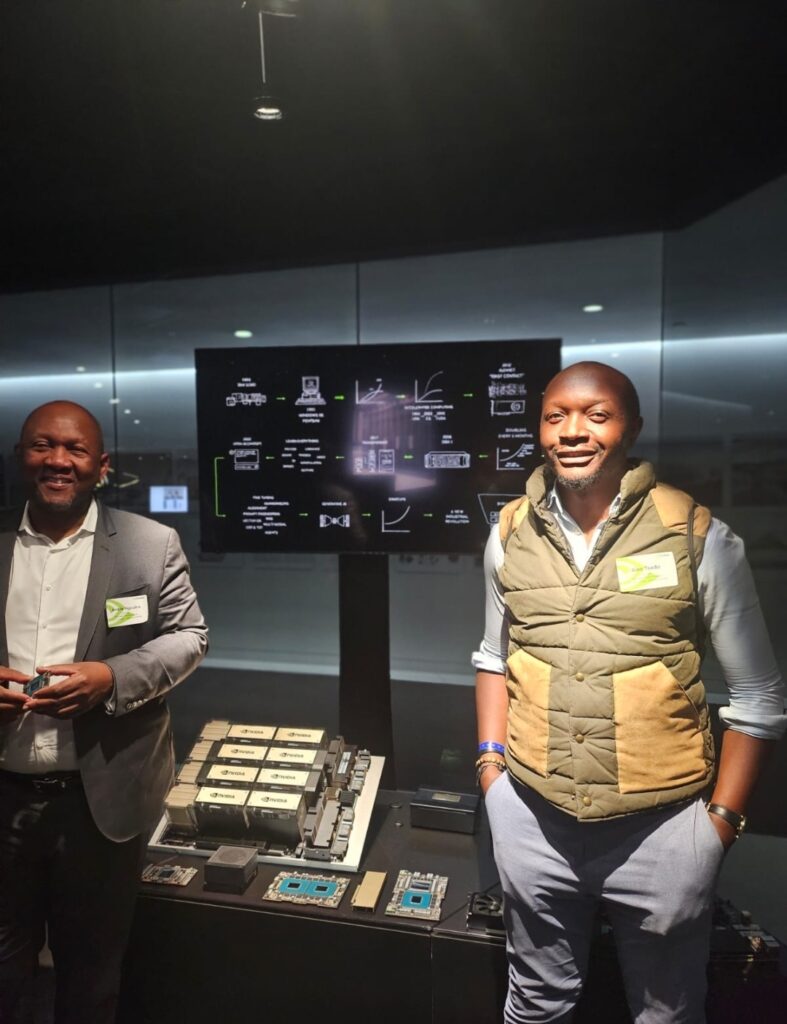
The founder possesses an Nvidia Spark which costs about $8,000 with customs. It is small enough to hold in one hand.
He says he has been shipping them to companies in Ghana, Benin Republic, and Nigeria.
He is not waiting to find out whether the mission is worth pursuing. He is pursuing it on the assumption that it is, six years into a ten-year plan he made when he left Nvidia, with the same deliberate sequencing that has defined every previous chapter of his career.
Failure is a function of time and resilience. He said that himself.
And he does possess both.
This article is drawn from an in-depth founder interview conducted by Afriq IQ with Alexander Tsado, the founder and CEO of Udu Technologies. Selected insights and observations are published here.
Ready to Ace Your Next Funding Pitch?
Join thousands of founders who have improved their pitch skills and secured funding with our automated interview simulator.