How Reedapt is Amplifying African Voices on the Global Stage
FOUNDER SNAPSHOT
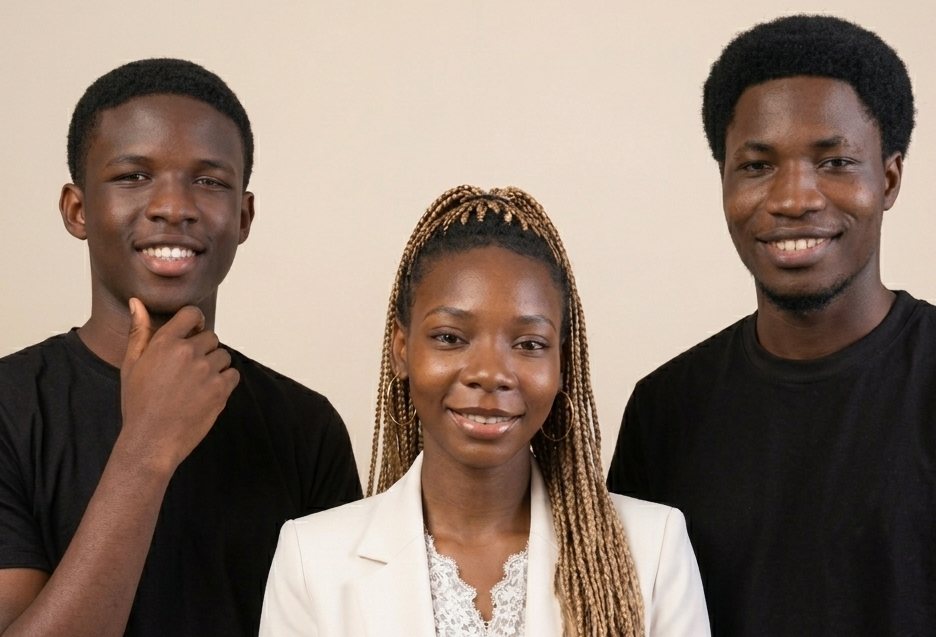
Owoade, Maryann and Emmanuel
STARTUP
Reedapt
STAGE
Early traction
GEOGRAPHY
Nigeria • United States
SECTOR
Language technology
Where It Started
Reedapt was not conceived in a pitch competition or a hackathon. It came from genuine frustration with something the founders felt in their own lives.
One of the founders was not performing as expected in a French class.
He went to a francophone classmate and asked for help. The classmate refused and asked him what he was going to do with French anyway. It stung. Not just because of the refusal, but because of a pattern he had been noticing.
In the boarding school corridors, groups of students would be speaking English until someone walked in, at which point they would switch to French. Not for privacy exactly.
More to shut someone out.
The founder describes it plainly. He felt like a stranger in his own home because of a language gap.
Around the same time, he saw Star Trek for the first time. The universal translator captured something he had been feeling without knowing how to name it. The idea that you should be able to speak to anyone, in any language, without starting from scratch.
He then went to university to study foreign languages, not as surrender to the problem but as a deliberate decision to fight it from the inside.
That personal origin is worth dwelling on.
That kind of motivation tends to produce founders who are harder to stop, because they are not building for a market.
They are building for themselves.
The Problem Reedapt is Solving
There is a number buried in this conversation that deserves more attention than it typically gets.
On average, YouTube pays African creators far less than creators in Western markets. The reason is partly geography, partly advertiser preference, and partly language.
African content does not travel as far as it could because most of it stays in the language it was created in.
The founders put it simply:
“If African creators were being paid what their content deserves, Africa would be a much better place for storytellers.”
Traditional dubbing is not the answer. It is expensive. It takes months. It produces quality that varies wildly depending on whether the voice actors are fresh or exhausted.
One founder who worked in quality control at one of Africa’s biggest dubbing agencies describes watching the energy drain out of a production over three months.
By the midpoint, people were voicing five or ten characters simultaneously. The errors would stack up.
The consistency that technology provides by design was the thing that human fatigue kept undermining.
Hence, the founders are not just building a translation tool.
They are building an amplification infrastructure for voices that global platforms have systematically undervalued.
The Strategic Decision Layer
The most interesting product decision the founders made was not what to build. It was what to prioritise within what they built.
Voice translation at a surface level is already available. Google Translate exists. Other AI dubbing platforms exist.
The founders studied those tools carefully and found a consistent gap. The existing tools were not built for the African context.
They were not trained on “Nigerian English”. They could not handle the way some speakers pronounce certain consonants differently.
They could not manage incantations, indigenous phrases, or the specific cadence of Pentecostal preaching, which is one of the largest audio content categories on the continent.
The founders describe an error that could possibly occur during translation.
A pastor preaching on stage could say the phrase “the grace of God” but a model receiving that could translate it as “disgrace of God.”
That single error is not a minor quality issue. In the context of religious broadcasting to millions of people, it is the kind of misrepresentation that ends partnerships and invites legal exposure.
So the team made a deliberate choice to prioritise three things: voice cloning, emotional accuracy, and African contextual understanding.
Those three pillars are what distinguish the product from anything built for a generalised global market.
The goal is not to translate words. It is to transfer meaning, tone, and identity from one language to another without leaving any of it behind.
The B2B pivot mentioned in the discussions is also worth examining.
The founders originally assumed that a universal translator would find a universal audience.
The data corrected them quickly.
Reedapt is not a product that someone uses on a random Tuesday.
It is a professional tool for people whose income, audience reach, or institutional communication depends on reaching audiences in other languages.
Instances could include churches broadcasting internationally, movie producers expanding distribution, and creators who have built audiences in one language and want to enter another.
One founder uses an analogy that is both funny and exact. Anime fans, for instance, do not go out of their way to find raw Japanese footage and dub it themselves.
They go to the site that already has the dubbed version waiting for them.
Reedapt’s customers are the people who make the dubbed version that everyone else downloads.
That is a much smaller audience but a much more motivated one.
Recent commercial movement appears to support that thesis.
Since the original discussion, the founders report securing a new enterprise church partnership worth several thousand dollars.
The organisation is using Reedapt’s live translation infrastructure to expand multilingual access during live broadcasts and ministry content distribution.
More important than the contract value itself is what the engagement validates.
Religious broadcasting environments are among the least tolerant of translation inaccuracies, tonal distortion, or contextual misunderstanding.
Adoption in that setting suggests the product is beginning to earn institutional trust rather than casual experimentation.
Ecosystem Context
The data gap for African AI is a structural problem, and the founders speak about it with unusual honesty.
Training an AI model to understand African voices accurately requires data that does not currently exist at the necessary scale.
The generic datasets available on open-source platforms were not built for this purpose.
They cannot capture how specific Nigerian creators speak, the rhythm of a Yoruba intonation, or the emotional register of a preacher mid-sermon.
The founders are collecting data themselves and working with what is available through open-source licensing.
They are also thinking about the problem from a different angle. Rather than trying to out-train larger competitors on volume, they are focused on data quality that is specific to the audience they serve.
A million low-quality data points for a generalised model will not outperform a smaller, carefully curated dataset that actually captures how the target speaker sounds.
This is not a solved problem. The founders say so openly.
Even large competitors face the same constraint. What the founders believe is that proximity to the problem gives them an advantage in identifying the right data, not just any data.
There is also a broader observation embedded in this conversation that goes beyond Reedapt.
The founders describe how YouTube’s payment structure, the dominance of Western content on global platforms, and the absence of localisation tools have all combined to keep African voices from reaching the audiences they deserve.
The language barrier is not just a product problem. It is an economic infrastructure problem.
Reedapt is attempting to build at the product layer, but the problem they are responding to operates at the system level.
Observed Patterns
Most AI startups are engineer-led and the product being built can in many ways reflect the priorities of the people who built it.
But Reedapt has a profoundly rare configuration.
The person driving the vision studied foreign languages.
The machine learning lead built her undergraduate thesis on sign language to speech conversion and was so compelling in her presentation that the panel chairman stopped her mid-explanation and asked her to just show what it does.
The engineers bring front-end, back-end, and system experience. The product sensibility is driven by someone who thinks constantly about how people perceive what they are experiencing.
That combination produces a product built around human experience rather than just technical capability.
The freemium model, the 60-minute free tier for new users, the focus on B2B relationships with churches and film producers, etc. are all decisions made by people who understand their users as humans with specific workflows and specific hesitations, not just as data points in a conversion funnel.
The resilience signal is also genuine.
The founders bootstrapped to nearly 300 users and multiple business clients with no external funding. They made it to the top 10 of the Startup World Cup and the Junior Chamber International (JCI) Creative Young Entrepreneur (CYE) pitch competition.
Since the original interview, the team also reports closing a new enterprise church partnership worth several thousand dollars centred on live multilingual translation infrastructure.
The progression from individual users toward institutional deployment is strategically more significant than raw user volume at this stage.
One founder describes the approach as finding customers whose business will genuinely suffer without the product, which is advice they received from a well-known accelerator investor and took seriously enough to restructure their sales approach around it.
Open Variables
The data problem is one of the most consequential challenges for Reedapt.
The founders acknowledge it directly.
Building models that accurately represent African voices at scale requires data that is not yet available in the volume or quality needed.
The competitors they face, some of them much better resourced, share this constraint. But better-resourced competitors can collect data faster.
Distribution is the second major variable.
The founders describe realising that they do not yet have the network reach to market effectively.
Building social media presence, collaborating with creators who have existing audiences, and developing guerrilla-style growth strategies are all work in progress.
The product is live. The audience for it is real. But connecting the two at scale, without a marketing budget, is a challenge the team is working through in real time.
Earlier discussions referenced portions of the commercial pipeline rather than fully realised revenue.
Since then, the founders report converting at least part of that pipeline into closed enterprise business through a new church partnership focused on multilingual live broadcasting infrastructure.
The distinction between pipeline momentum and repeatable revenue generation, however, remains material for anyone evaluating the company’s long-term commercial position.
Why This Matters
For founders building in language technology, this case makes an argument that product teams coming from outside a culture often miss.
The gap between technically correct translation and culturally accurate representation is not a refinement. It is the entire product.
Getting a word right and getting a meaning right are different things, and the difference becomes obvious the moment you put a model trained on general data in front of a church pastor, for instance, and then watch it turn “grace” into “disgrace”.
For investors, the creator economy framing is the right one for this market. YouTube’s payment gap between African and Western creators is a documented structural disadvantage.
Any tool that helps African creators reach multilingual audiences at a price point accessible to them addresses a real and large economic problem.
The recent enterprise church adoption also reinforces another emerging pattern within African AI markets: institutions with existing audiences and distribution networks may become some of the earliest commercially viable adopters of localisation infrastructure.
The question is execution speed against a competitive field that is also moving.
For accelerators and DFIs, the data infrastructure observation is the most actionable insight from this case.
African AI startups are consistently constrained not by ideas or ambition but by the absence of training data that reflects their context.
Investment in African voice and language data collection, at an ecosystem level rather than a company level, would benefit every startup in this space simultaneously.
Final Strategic Takeaway
One founder describes Canva as a product that on the worst days, when the electricity went out and the pressure was highest, was what he could reach for to prove himself.
That is what he is trying to build with Reedapt. Not the biggest tool in the room but the most reliable one.
The one an African creator can reach for on a difficult day in a market that has not always treated their work as worth the full price and know that their voice is going to come through exactly as they intended.
The vision is bold.
“They intend for Reedapt to be more effective and more trusted than Google Translate for African content.”
The founders say it without apology.
The market gap is real. The founding team is diverse in the right ways. The product is live, serving users, and beginning to secure institutional adoption.
The recently reported enterprise church partnership offers an early signal that the platform may be moving from experimental utility toward operational infrastructure within high-context communication environments.
What remains to be built is the distribution infrastructure to match the quality of what already exists.
In markets defined by who gets heard, building the tool that carries your voice further is not a niche product.
It is infrastructure.
This article is drawn from an in-depth founder interview conducted by Afriq IQ with Owoade Apotierioluwa, Maryann Nnaji and Emmanuel Ibiang, Co-founders of Reedapt. Selected insights and observations are published here.
Ready to Ace Your Next Funding Pitch?
Join thousands of founders who have improved their pitch skills and secured funding with our automated interview simulator.