How Izifin Is Turning AI Microservices Into a Multi-Sector Business
FOUNDER SNAPSHOT
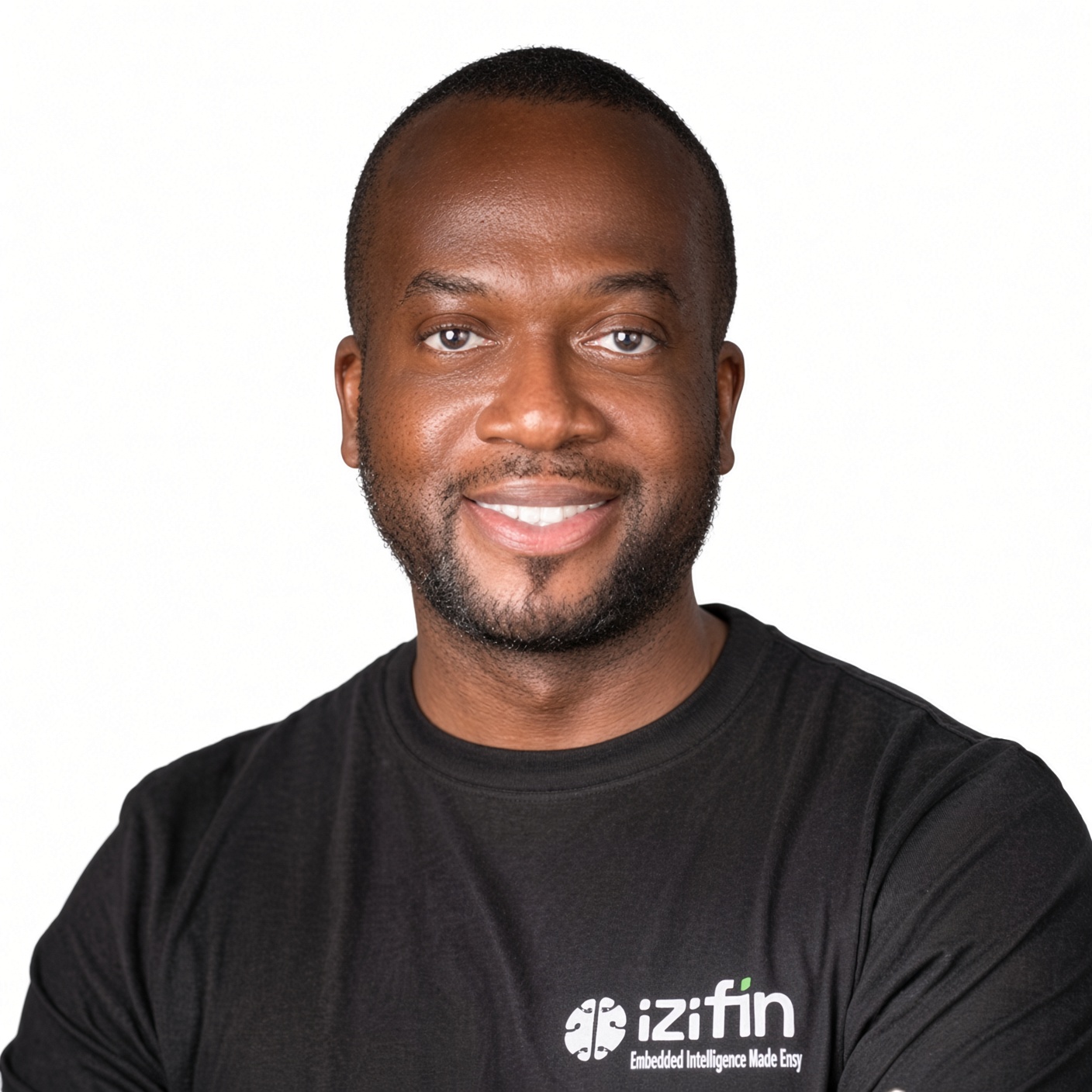
Dumebi Okwechime, PhD
STARTUP
Izifin
STAGE
Revenue generating
GEOGRAPHY
Nigeria, with pan-African ambitions
SECTOR
Fintech
The Core Problem
Across Nigeria and most of Africa’s informal economy, many businesses operate successfully without the formal documentation conventional financial systems often require.
For lenders, assessing their creditworthiness and affordability becomes difficult when traditional business data is missing.
For Dumebi Okwechime, founder of Izifin, this was an early lesson in AI’s potential.
His experience working on credit scoring for micro and small businesses showed how alternative data could support better financial decisions.
But he saw a wider opportunity: businesses across different sectors faced problems that AI could help solve, provided the technology was accessible and adapted to their needs.
Izifin was born out of the desire to offer SMEs a suite of Artificial Intelligence driven products with simple API integrations, to expand on their existing business propositions to their customers.
The Strategic Decision Layer
Rather than positioning Izifin around a single application, the founder describes a flexible operating system (OS) architecture, comprising AI-focused microservices that can be combined to address different business problems.
The company’s approach has evolved from financial decisioning models for banks into embedded finance, buy-now-pay-later services, digital storefronts and healthcare payments.
Its solution extends commerce into WhatsApp, allowing businesses to reach customers without requiring them to download another application or visit a separate website.
The underlying strategy is to build reusable capabilities and adapt them as customer demand emerges.
This creates an important trade-off.
Flexibility can help a company respond to opportunities, but serving many sectors can also stretch product development and commercial focus.
Izifin’s challenge is to turn that adaptability into repeatable offerings rather than an endless sequence of bespoke solutions.
The Ecosystem Context
Financial services remain Izifin’s foundation.
Payments, credit and financial decision-making sit at the centre of almost every business, making finance a natural starting point for AI-enabled efficiency.
From that base, the company has moved closer to the transactions themselves.
In healthcare, for example, embedded financing can allow a patient to seek payment approval within a hospital’s invoicing process rather than navigating separate borrowing channels.
Meanwhile, digital storefronts and WhatsApp commerce offer alternative ways for merchants to reach customers and transact.
These examples point to a broader opportunity: AI’s value may lie not simply in automating tasks, but in connecting businesses, customers and financial services at the moment a transaction happens.
Yet, the informal economy is not one uniform market. Some merchants want to expand; others are content with existing operations and see little reason to change.
Adoption depends on solving a sufficiently urgent problem not merely introducing new technology.
Observed Signals
Several important signals emerge from Izifin’s development and operations namely:
Customer-led expansion
The company’s direction is shaped by demand, rather than just a rigid commitment to one industry.
A reusable technology base
A bespoke OS architecture is intended to let the company combine existing capabilities to build solutions across different use cases.
Practical distribution thinking
Izifin targets businesses with clear needs, such as stock management, theft concerns, transaction reconciliation or expansion into new markets.
Referrals from existing customers are an important part of its approach.
Learning through iteration
An anomaly-detection product that initially struggled to find a suitable customer was later adapted for a fintech dealing with cross-border payment anomalies.
Open Variables
One of the central questions at this stage of Izifin’s development could be whether it can maintain flexibility without sacrificing focus.
Can its microservices support multiple customers with limited additional development, or will each new opportunity require substantial custom work?
Also, which products and sectors will ultimately generate the strongest recurring revenue? And can the company reach smaller businesses at a cost that makes adoption commercially viable?
These questions present real opportunities for Izifin in the course of its operations as it continues to scale.
Regulation adds another layer. New compliance requirements do sometimes seem to emerge as Izifin enters different activities or works with new partners.
The company views adapting to these requirements as part of building its capabilities, but the long-term operational cost remains an important consideration.
Why This Matters
Izifin’s story reflects wider challenges for AI businesses operating in emerging markets one of which is that identifying a useful model is only one part of building a viable company.
Businesses also need distribution, integration into existing workflows, access to customers and a commercial model that reflects what those customers can afford.
For the informal economy in particular, technology adoption cannot be assumed. The strongest entry points may be businesses already experiencing a clear operational problem and actively seeking growth.
Their results and referrals could help demonstrate value to a wider market.
For investors and ecosystem observers, Izifin raises a useful question: Can a common AI infrastructure serve multiple markets without making the business too diffuse to scale?
Final Strategic Takeaway
Izifin is pursuing a model in which financial services provide the foundation, reusable AI capabilities provide flexibility, and customer demand helps determine where the company expands next.
That approach offers a way to navigate markets where needs evolve and product opportunities do not always fit neatly into one sector.
But flexibility is a means, not an outcome.
Its advantage will not simply be the ability to build different solutions. It will be the ability to identify which solutions are worth scaling and to do so consistently.
This article is drawn from an in-depth founder interview conducted by Afriq IQ with Dumebi Okwechime, PhD, Founder of Izifin. Selected insights and observations are published here.
Ready to Ace Your Next Funding Pitch?
Join thousands of founders who have improved their pitch skills and secured funding with our automated interview simulator.